

Historical Figure
Wilbur Wright
1867–1912
American aviation pioneers, inventors of the airplane
Talk to Wilbur Wright
Have a conversation with this historical figure through AI
Biography
The Wright brothers, Orville Wright and Wilbur Wright, were American aviation pioneers generally credited with inventing, building, and flying the world's first successful airplane. They made the first controlled, sustained flight of an engine-powered, heavier-than-air aircraft with the Wright Flyer on December 17, 1903, four miles (6 km) south of Kitty Hawk, North Carolina, at what is now known as Kill Devil Hills. In 1904 the Wright brothers developed the Wright Flyer II, which made longer-duration flights including the first circle, followed in 1905 by the first truly practical fixed-wing aircraft, the Wright Flyer III.
Timeline
The story of Wilbur Wright, told in moments.
Born near Millville, Indiana. Third of five children. His father is a bishop in the Church of the United Brethren. Neither Wilbur nor his brother Orville finish high school. A hockey accident knocks out Wilbur's front teeth and keeps him homebound for three years. He reads voraciously.
Opens the Wright Cycle Exchange in Dayton, Ohio, with Orville. They build, sell, and repair bicycles. The shop earns enough to fund their real interest: human flight. They read everything Otto Lilienthal and Octave Chanute publish.
Writes to the Smithsonian Institution requesting all available research on flight. He develops the concept of wing warping after observing how pigeons tilt their wings to turn. He tests it with a five-foot kite. It works.
Orville pilots the first powered flight at Kitty Hawk, North Carolina. Twelve seconds, 120 feet. Wilbur's turn comes on the fourth flight of the day: 59 seconds, 852 feet. A gust of wind destroys the Flyer afterward. Only five people witness it.
Pilots the Wright Flyer III for 24 miles in 39 minutes over Huffman Prairie near Dayton. It's the first practical airplane, capable of sustained, controlled flight. Almost nobody is paying attention. The brothers refuse to demonstrate publicly until they secure patents.
Flies publicly for the first time at a racecourse in Le Mans, France. Spectators and rival aviators are stunned. The Wrights can bank, turn, and fly figure-eights. Nobody in Europe can do this. A French journalist writes: "We are beaten."
Dies of typhoid fever in Dayton, Ohio. He's 45. He never married, never earned a college degree, and never flew again after 1910. Orville lives until 1948, long enough to see the sound barrier broken.
In Their Own Words (9)
Herr Otto Lilienthal seems to have been the first man who really comprehended that balancing was the first instead of the last of the great problems in connection with human flight. He began where others left off, and thus saved the many thousands of dollars that it had theretofore been customary to spend in building and fitting expensive engines to machines which were uncontrollable when tried. He built a pair of wings of a size suitable to sustain his own weight, and made use of gravity as his motor. This motor not only cost him nothing to begin with, but it required no expensive fuel while in operation, and never had to be sent to the shop for repairs. It had one serious drawback, however, in that it always insisted on fixing the conditions under which it would work. These were, that the man should first betake himself and machine to the top of a hill and fly with a downward as well as a forward motion. Unless these conditions were complied with, gravity served no better than a balky horse — it would not work at all...We figured that Lilienthal in five years of time had spent only about five hours in actual gliding through the air. The wonder was not that he had done so little, but that he had accomplished so much. It would not be considered at all safe for a bicycle rider to attempt to ride through a crowded city street after only five hours’ practice, spread out in bits of ten seconds each over a period of five years; yet Lilienthal with this brief practice was remarkably successful in meeting the fluctuations and eddies of wind gusts. We thought that if some method could be found by which it would be possible to practice by the hour instead of by the second there would be hope of advancing the solution of a very difficult problem.
Speech to the Western Society of Engineers (18 September 1901); published in the Journal of the Western Society of Engineers (December 1901); republished with revisions by the author for the Annual Report of the Board of Regents of the Smithsonian Institution (1902), 1902
The person who merely watches the flight of a bird gathers the impression that the bird has nothing to think of but the flapping of its wings. As a matter of fact this is a very small part of its mental labor. To even mention all the things the bird must constantly keep in mind in order to fly securely through the air would take a considerable part of the evening. If I take this piece of paper, and after placing it parallel with the ground, quickly let it fall, it will not settle steadily down as a staid, sensible piece of paper ought to do, but it insists on contravening every recognized rule of decorum, turning over and darting hither and thither in the most erratic manner, much after the style of an untrained horse. Yet this is the style of steed that men must learn to manage before flying can become an everyday sport. The bird has learned this art of equilibrium, and learned it so thoroughly that its skill is not apparent to our sight. We only learn to appreciate it when we try to imitate it. Now, there are two ways of learning to ride a fractious horse: One is to get on him and learn by actual practice how each motion and trick may be best met; the other is to sit on a fence and watch the beast a while, and then retire to the house and at leisure figure out the best way of overcoming his jumps and kicks. The latter system is the safest, but the former, on the whole, turns out the larger proportion of good riders. It is very much the same in learning to ride a flying machine; if you are looking for perfect safety, you will do well to sit on a fence and watch the birds; but if you really wish to learn, you must mount a machine and become acquainted with its tricks by actual trial.
Speech to the Western Society of Engineers (18 September 1901); published in the Journal of the Western Society of Engineers (December 1901); republished with revisions by the author for the Annual Report of the Board of Regents of the Smithsonian Institution (1902), 1902
For some years I have been afflicted with the belief that flight is possible to man. My disease has increased in severity and I feel that it will soon cost me an increased amount of money if not my life. I have been trying to arrange my affairs in such a way that I can devote my entire time for a few months to experiment in this field.
Letter to (13 May 1900), 1900
Lilienthal’s enthusiastic efforts to arouse others may yet prove his most valuable contribution to the solution of the problem. What one man can do himself directly is but little. If however he can stir up ten others to take up the task he has accomplished much.
Letter to Octave Chanute (1 June 1900), 1900
Hawks are better soarers than buzzards but more often resort to flapping because they wish greater speed. A damp day is unfavorable for soaring unless there is a high wind. No bird soars in a calm. The object of the tail is to increase the spread of surface in the rear when the wings are moved forward in light winds and thus preserve the centre of pressure at about the same spot. It seems to be used as a rudder very little. In high winds it is folded up very narrow.
Wright's Notebook (1900), 1900
Artifacts (15)

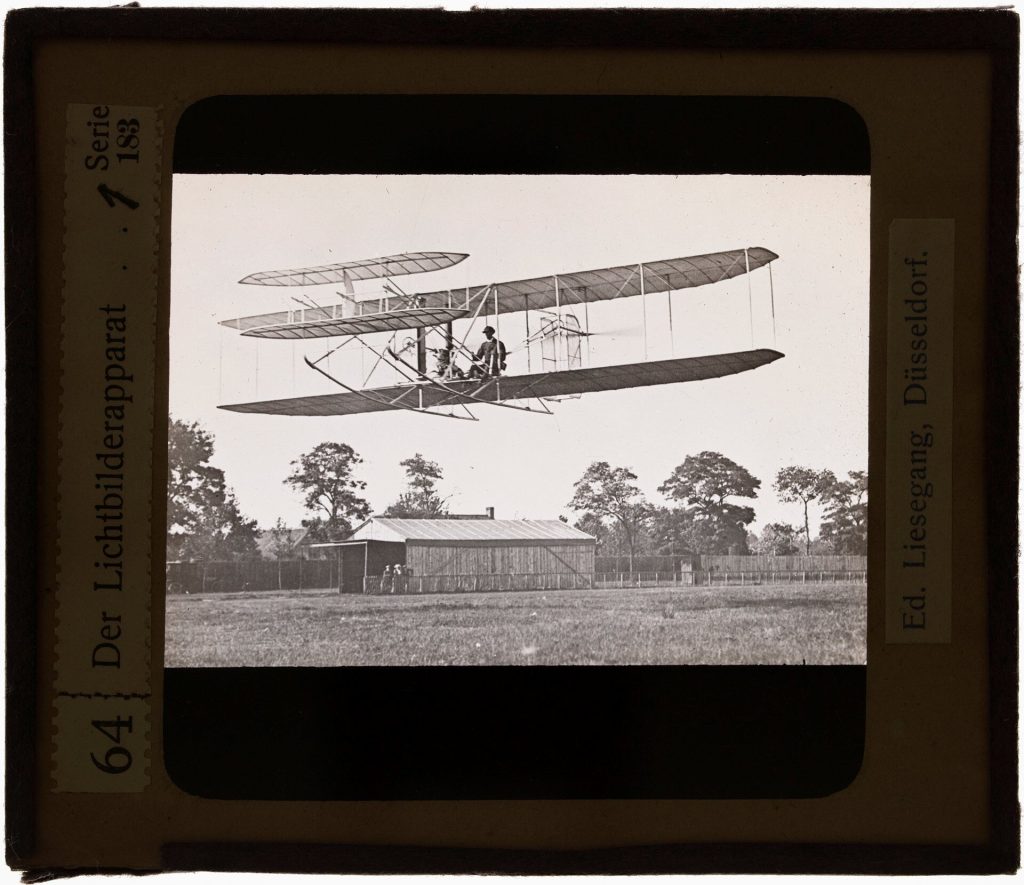
![[Wilbur Wright, 1908] : [photographie de presse] / [Agence Rol]](http://gallica.bnf.fr/iiif/ark:/12148/btv1b69110273/f1/full/512,/0/native.jpg)
[Wilbur Wright, 1908] : [photographie de presse] / [Agence Rol]
Rol agency. Photographic agency
![[Wilbur Wright, 1908] : [photographie de presse] / [Agence Rol]](http://gallica.bnf.fr/iiif/ark:/12148/btv1b6911026p/f1/full/512,/0/native.jpg)
[Wilbur Wright, 1908] : [photographie de presse] / [Agence Rol]
Rol agency. Photographic agency

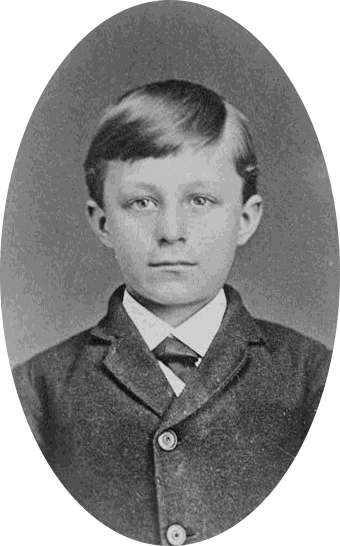

The First Successful Aircraft Flights by the Wright Brothers in the United States, 1903 Q83938
More from the Victorian Era


Explore what happened on the days that shaped Wilbur Wright's life. Today In History connects historical figures with the events, births, and deaths that defined their era. Browse all historical figures or explore today's events.