

Historical Figure
Mahatma Gandhi
1869–1948
Indian independence activist (1869–1948)
What do you want Mahatma Gandhi to say?
Sign up free to hear it.
Hear the original recording — “Spiritual Message to the World” (October 17, 1931) →
Talk to Mahatma Gandhi
Have a conversation with this historical figure through AI
Biography
Mohandas Karamchand Gandhi was an Indian lawyer, anti-colonial nationalist, and political thinker who employed nonviolent resistance to lead the successful campaign for India's independence from British rule. He inspired movements for civil rights and freedom across the world. The honorific Mahātmā, first applied to him in South Africa in 1914, is used worldwide.
Timeline
The story of Mahatma Gandhi, told in moments.
Born Mohandas Karamchand Gandhi in Porbandar, a coastal town in Gujarat, India. His father is the dewan (chief minister) of Porbandar. A shy, ordinary child. Married at 13 in an arranged ceremony.
Sails to South Africa to represent an Indian merchant in a lawsuit. He plans to stay one year. He stays 21. On a train from Durban to Pretoria, a white passenger objects to sharing a first-class compartment with him. Gandhi, holding a valid first-class ticket, refuses to move. He's thrown off the train at Pietermaritzburg station. He spends the night shivering in the waiting room. He later calls this the most creative experience of his life.
Coins the term "Satyagraha" (truth-force) to describe his method of nonviolent resistance in South Africa. He deliberately rejects the English term "passive resistance" because there is nothing passive about it.
Adopts the loincloth as his only garment. He has been wearing Western suits and then Indian formal dress. The switch is deliberate. He wants to dress like the poorest Indian. The image becomes iconic. Churchill calls him "a seditious fakir, striding half-naked." Gandhi considers it a compliment.
Begins the Salt March from Sabarmati Ashram to the coastal village of Dandi, 240 miles away. The British have a monopoly on salt. Making your own is illegal. Gandhi walks for 24 days. Thousands join him along the route. On April 6, he bends down and picks up a lump of natural salt from the mud. "With this," he says, "I am shaking the foundations of the British Empire."
Begins a fast unto death in Yerwada Jail to protest the British proposal for separate electorates for untouchables. He believes it will divide Hindu society permanently. B.R. Ambedkar, the leader of the untouchable community, is furious. He sees separate electorates as protection. They reach a compromise. Gandhi breaks his fast after six days.
Launches the Quit India movement, demanding immediate British withdrawal. He is arrested the next day. The British imprison him at the Aga Khan Palace in Pune. His wife Kasturba and his secretary Mahadev Desai both die there during his captivity. He is released in 1944 due to failing health.
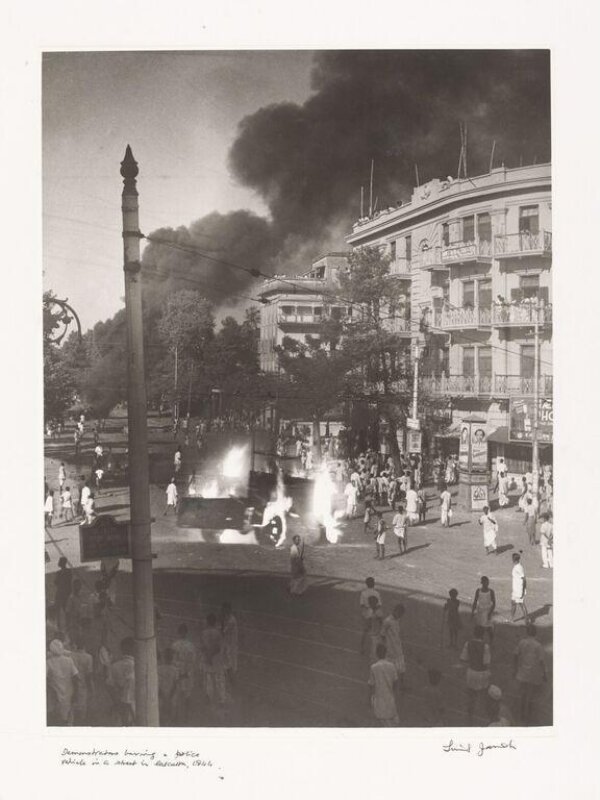
India gains independence. Gandhi doesn't celebrate. He is in Calcutta, trying to stop Hindu-Muslim riots. The partition of British India into India and Pakistan triggers the largest mass migration in history. Between 10 and 20 million people cross the new borders. Up to two million die in the violence.
Shot three times at close range by Nathuram Godse, a Hindu nationalist, while walking to an evening prayer meeting in New Delhi. He is 78. Godse believes Gandhi has been too sympathetic to Muslims and Pakistan. Gandhi's last words are disputed. The traditional account says he called out "He Ram" (Oh God). He dies within minutes.
The United Nations General Assembly declares October 2 (Gandhi's birthday) the International Day of Non-Violence. His face appears on every denomination of Indian currency. He never held public office.
In Their Own Words (20)
It would be a great things, a brave thing, for the Hindus to achieve act of self-denial.
Young India (12 March 1931), Selections from Gandhi (1950), Nirmal Kumar Bose, p. 161., 1950
I do feel that spiritual progress does demand at some stage—an inexorable demand—that we should cease to kill our fellow-creatures for satisfaction of our bodily wants.
Speech at Meeting in Lausanne (8 December 1931), in The Collected Works of Mahatma Gandhi (New Delhi: Publications Division Government of India, 1999 electronic edition), Volume 54, p. 272., 1931
"The only tyrant I accept in this world is the 'still small voice' within me. And even though I have to face the prospect of being a minority of one, I humbly believe I have the courage to be in such a hopeless minority."
Speech at the Kingsley Hall, London, 4 October 1931, in The Collected Works of Mahatma Gandhi, Vol. 48, p. 340., 1931
Vegetarians should have that moral basis—that a man was not born a carnivorous animal, but born to live on the fruits and herbs that the earth grows.
Speech at Meeting of London Vegetarian Society (20 November 1931), in The Collected Works of Mahatma Gandhi (New Delhi: Publications Division Government of India, 1999 electronic edition), Volume 54, p. 189., 1931
The weak can never forgive. Forgiveness is the attribute of the strong.
"Interview to the Press" in Karachi about the execution of Bhagat Singh (23 March 1931); published in Young India (2 April 1931), reprinted in Collected Works of Mahatma Gandhi Online Vol. 51. Gandhi begins by making a statement on his failure "to bring about the commutation of the death sentence of Bhagat Singh and his friends." He is asked two questions. First: "Do you not think it impolitic to forgive a government which has been guilty of a thousand murders?" Gandhi replies: "I do not know a single instance where forgiveness has been found so wanting as to be impolitic." In a follow-up question, Gandhi is asked: "But no country has ever shown such forgiveness as India is showing to Britain?" Gandhi replies: "That does not affect my reply. What is true of individuals is true of nations. One cannot forgive too much. The weak can never forgive. Forgiveness is the attribute of the strong.", 1931
Artifacts (15)

Mahatma Gandhi, Birth Centenary of Mahatma Gandhi, Republic of Cyprus
Cyprus Post, Republic of Cyprus
Mahatma Gandhi, Birth Centenary of Mahatma Gandhi, Republic of Cyprus
Cyprus Post, Republic of Cyprus
Mahatma Gandhi, Birth Centenary of Mahatma Gandhi, Republic of Cyprus
Cyprus Post, Republic of Cyprus
Mahatma Gandhi, Birth Centenary of Mahatma Gandhi, Republic of Cyprus
Cyprus Post, Republic of Cyprus

Mahatma Gandhi ._x000D_ April 1931 .
http://www.wikidata.org/entity/Q110975090
More from the Victorian Era


Explore what happened on the days that shaped Mahatma Gandhi's life. Today In History connects historical figures with the events, births, and deaths that defined their era. Browse all historical figures or explore today's events.