
Today In History logo TIH
Albert Einstein

Historical Figure

Albert Einstein

1879–1955

German-born theoretical physicist (1879–1955)

Victorian Era

Character Profile

The Question

Albert Einstein

He’d ask you what time you got up this morning. Before you answered, he’d already be smiling — because he’s going to ask you next how you know.

Einstein’s famous quotes are mostly about imagination. That’s because he couldn’t shut up about it. He built his physics inside out, from the passenger’s seat. What would it look like to ride a beam of light? What would you see from a falling elevator? What does a clock do when it moves? The thought experiments weren’t illustrations of his theories — they WERE his theories. The math came later, after a lifetime of chasing mental images around a patent office in Bern.

Talk to Einstein and you notice immediately that he’d rather ask than answer. Every question you put to him, he turns into a better one. You’d ask about relativity, he’d ask whether you’ve ever gotten seasick — and then, whether the room or your stomach seemed to be moving. He’d lead you to the answer by making you feel it before you could name it. Then he’d nod at you, pleased, as if you’d discovered it yourself.

When you push him on the harder stuff — the letter to Roosevelt in 1939, the atomic bomb, whether he regrets any of it — his tone shifts. He stops asking. He’s telling you now, and the telling is blunt. “A happy man is too satisfied with the present to dwell too much on the future.” He wasn’t a happy man by that definition. He dwelled.

The thing he’d teach you without you realizing: you already think like a physicist. You just don’t trust it. The whole point of relativity, he’d say, is that common sense is provisional — and when common sense disagrees with your experience, experience wins. Your clock is your clock. Your speed is your speed. There’s no universal referee. That’s not a mathematical claim. That’s a claim about humility. He wanted you to see that most of the mistakes people make — in physics, in politics, in love — come from believing that their frame of reference is the one everyone else is using.

Don’t ask him about God playing dice. He’s answered that one too many times. Ask him about his first wife. Ask him about his son Eduard in the Swiss asylum. Ask him, if he could do the letter to Roosevelt over, whether he’d sign it again.


Three questions to start with:

  • You said God doesn’t play dice with the universe, and then quantum mechanics turned out to. How did you reconcile that by the end?
  • If you had stayed in Berlin after 1933, what do you think you would have written?
  • You signed the letter to Roosevelt. You said later you would not have, if you had known. Walk me through that regret.
Hear Their Voice

Original recordings and AI voice

Original Speech

"On the Intellect" — 1943

AI Voice Clone

Generated by Today in History

Talk to Albert Einstein

Have a conversation with this historical figure through AI

Biography

Albert Einstein was a German-born theoretical physicist best known for developing the theory of relativity. Einstein also made important contributions to quantum theory. His mass–energy equivalence formula E = mc2, which arises from special relativity, has been called "the world's most famous equation". He received the 1921 Nobel Prize in Physics for "his services to theoretical physics, and especially for his discovery of the law of the photoelectric effect".

Read more on Wikipedia

Timeline

The story of Albert Einstein, told in moments.

1896 Life

Renounces his German citizenship at 17 to avoid military service. He is stateless for five years. He enrolls at the Swiss Federal Polytechnic in Zurich, where he skips most of his classes and reads physics on his own.

1905 Event

Publishes four papers in a single year while working as a patent clerk in Bern. Photoelectric effect. Brownian motion. Special relativity. Mass-energy equivalence. He is 26. Nobody at the patent office knows.

1915 Event

Presents the field equations of general relativity to the Prussian Academy of Sciences. Ten years of work. The theory replaces Newton's law of gravitation, which had held for 228 years.

1919 Event

A solar eclipse over West Africa confirms general relativity. Light bends around the sun exactly as Einstein predicted. Newspapers worldwide run the story. He wakes up famous.

1921 Event

Awarded the Nobel Prize in Physics. Not for relativity. For the photoelectric effect, from that 1905 paper. The committee considered relativity too controversial.

1927 Event

Attends the Fifth Solvay Conference in Brussels. Twenty-nine physicists. The photo becomes the most famous group portrait in science. Einstein spends the week arguing with Niels Bohr about quantum mechanics. He loses. He never accepts it.

1933 Event

Flees Nazi Germany and settles in Princeton, New Jersey. He'll never return to Europe. His books are burned in Berlin. His property is seized. His name appears on a Nazi bounty list with a ,000 price on his head.

1955 Death

Dies at Princeton Hospital of an abdominal aortic aneurysm. He is 76. He refuses surgery. "I want to go when I want," he tells his doctor. "It is tasteless to prolong life artificially." The pathologist on duty steals his brain during the autopsy. It won't be returned to his family for decades.

Show full timeline (11 entries)
1939 Event

Signs a letter to President Roosevelt warning that Germany might build an atomic bomb. The letter, drafted by Leo Szilard, leads to the Manhattan Project. Einstein later calls signing it the greatest mistake of his life.

1952 Event

Offered the presidency of Israel after Chaim Weizmann dies. He declines. He is 73, a theoretical physicist in Princeton, and he says he lacks the natural aptitude for dealing with people.

1999 Legacy

Time magazine names Einstein the Person of the Century. Not of the year. Of the hundred years.

In Their Own Words (20)

In Lenin I honor a man, who in total sacrifice of his own person has committed his entire energy to realizing social justice. I do not find his methods advisable. One thing is certain, however: men like him are the guardians and renewers [Erneuerer] of mankind's conscience.

Quoted in Einstein on Politics, Princeton University Press, 2013, ISBN 9781400848287., 2013

I am neither a German citizen nor do I believe in anything that can be described as a "Jewish faith." But I am a Jew and glad to belong to the Jewish people, though I do not regard it in any way as chosen.

Letter to Central Association of German Citizens of the Jewish Faith, 3 [5] April 1920, as quoted in Alice Calaprice, The Ultimate Quotable Einstein (2010), p. 195; citing Israelitisches Wochenblatt, 42 September 1920, The Collected Papers of Albert Einstein, Vol. 7, Doc. 37, and Vol. 9, Doc 368., 2010

Nature shows us only the tail of the lion. But there is no doubt in my mind that the lion belongs with it even if he cannot reveal himself to the eye all at once because of his huge dimension. We see him only the way a louse sitting upon him would.

Letter to Heinrich Zangger (10 March 1914), quoted in The Curious History of Relativity by Jean Eisenstaedt (2006), p. 126., 2006

A happy man is too satisfied with the present to dwell too much on the future.

From "Mes Projets d'Avenir", a French essay written at age 18 for a school exam (18 September 1896). The Collected Papers of Albert Einstein Vol. 1 (1987) Doc. 22., 1987

No one can read the Gospels without feeling the actual presence of Jesus. His personality pulsates in every word. No myth is filled with such life.

As reported in Einstein — A Life (1996) by Denis Brian, when asked about a clipping from a magazine article reporting his comments on Christianity as taken down by Viereck, Einstein carefully read the clipping and replied, " That is what I believe." ., 1929

Artifacts (15)

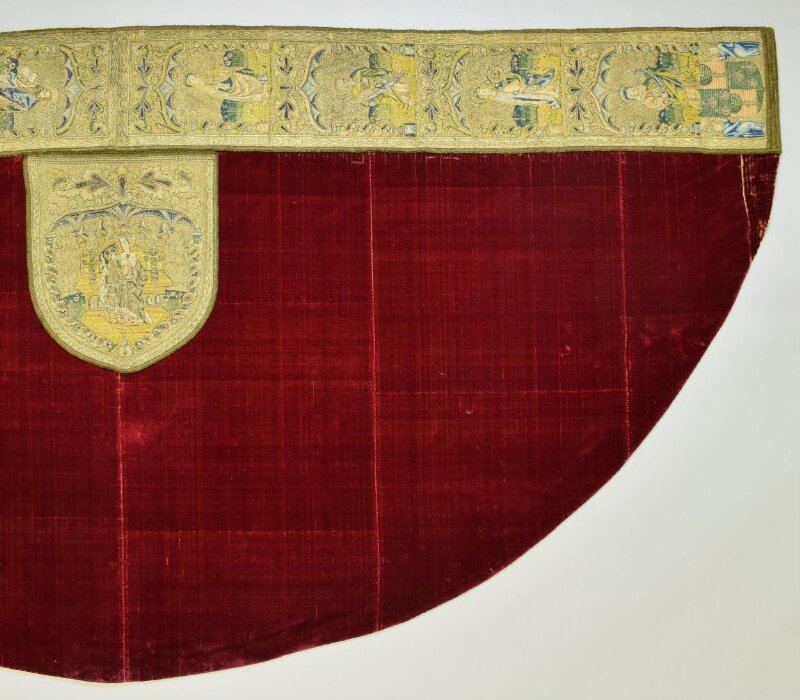
Untitled

1450-75
vam View

Albert Einstein

Still image
europeana View

Albert Einstein

Still image
europeana View

Albert Einstein

europeana View

Albert Einstein

Two-dimensional nonprojectable graphic
europeana View

Albert Einstein

kép
europeana View

Albert Einstein

http://www.wikidata.org/entity/Q110975090

Photography, Professional photography
europeana View

Albert Einstein

Two-dimensional nonprojectable graphic
europeana View

Albert Einstein

http://www.wikidata.org/entity/Q110975090

Photography, Professional photography
europeana View

Albert Einstein

Two-dimensional nonprojectable graphic
europeana View

Porträtaufnahme Albert Einstein

Archivale
europeana View

Porträtaufnahme Albert Einstein

Archivale
europeana View

Albert Einstein [Illustration] : nach einer Original-Radierung

Hermann Struck

1924

Albert Einstein with Robert Andrews Millikan in Geneva, Switzerland.

unknown

1924

Porträtbüste Professor Albert Einstein [Illustration]

Moshe Ziffer

1930

More from the Victorian Era

Explore what happened on the days that shaped Albert Einstein's life. Today In History connects historical figures with the events, births, and deaths that defined their era. Browse all historical figures or explore today's events.