

Historical Figure
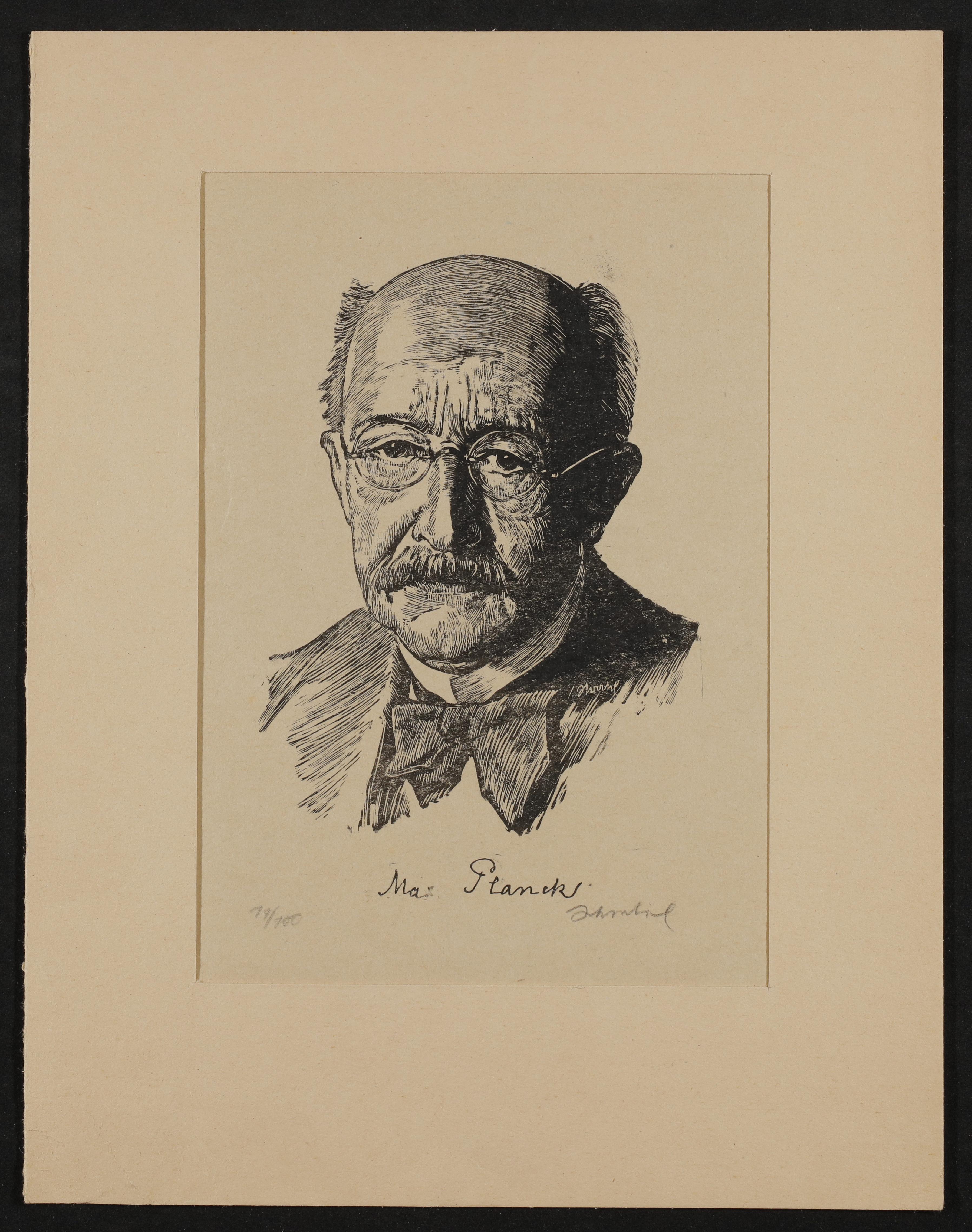
Max Planck
1858–1947
German theoretical physicist (1858–1947)
Talk to Max Planck
Have a conversation with this historical figure through AI
Biography
Max Karl Ernst Ludwig Planck was a German theoretical physicist. He won the 1918 Nobel Prize in Physics "for the services he rendered to the advancement of physics by his discovery of energy quanta".
Timeline
The story of Max Planck, told in moments.
Completed his doctoral thesis at 21. His adviser Philipp von Jolly told him physics was essentially complete and there was nothing left to discover. Planck went ahead anyway.
Presented his quantum theory to the German Physical Society. Energy comes in discrete packets, not continuous waves. He didn't like the idea himself. Called it "an act of desperation."
Won the Nobel Prize in Physics for his discovery of energy quanta. Einstein had already used Planck's work to explain the photoelectric effect. The quantum revolution was underway.
His son Erwin was arrested by the Gestapo for involvement in the July 20 plot to assassinate Hitler. Planck wrote to Hitler personally, begging for clemency. Erwin was executed in January 1945.
In Their Own Words (20)
New scientific ideas never spring from a communal body, however organized, but rather from the head of an individually inspired researcher who struggles with his problems in lonely thought and unites all his thought on one single point which is his whole world for the moment.
Address on the 25th anniversary of the Kaiser-Wilhelm Gesellschaft (January 1936), as quoted in Surviving the Swastika : Scientific Research in Nazi Germany (1993), 1993
Farsighted theologians are now working to mine the eternal metal from the teachings of Jesus and to forge it for all time.
From Planck to Study (2 December 1913), (Autog. I/383, SPK); as quoted in The Dilemmas of an Upright Man : Max Planck As Spokesman for German Science (1986) by J. L. Heilbron, p. 67, 1986
In the limiting case, [entropy] stays the same. If it increases.., the process is irreversible. If it remains the same.., the process is reversible... [i.e.,] you can let it run backwards.
1942
Energy remains constant and entropy always grows and can never be reduced... [T]his is the essence of the second law of thermodynamics...the entropy of a system of bodies can... only increase.
1942
In physical-chemical equilibria, an American was faster... John Willard Gibbs... Regarding radiation equilibrium... I... built the foundations.
1942
Artifacts (15)

Max Planck
Friedrich Müller Photograph (Fotograf)


![MAX PLANCK [Material gráfico]](https://www.fotosantiguascanarias.org/oaistore/srvimg/img102/00014001_00014500/00014257/alta/00014257_0001.jpg)


Eight Lectures on Theoretical Physics: Delivered at Columbia University in 1909
Eight Lectures on Theoretical Physics, Delivered at Columbia University in 1909. Translated by A.P. Wills by Max Planck, first published in 1915, is a rare manuscript, the original residing in one...
More from the Victorian Era


Explore what happened on the days that shaped Max Planck's life. Today In History connects historical figures with the events, births, and deaths that defined their era. Browse all historical figures or explore today's events.