

Historical Figure
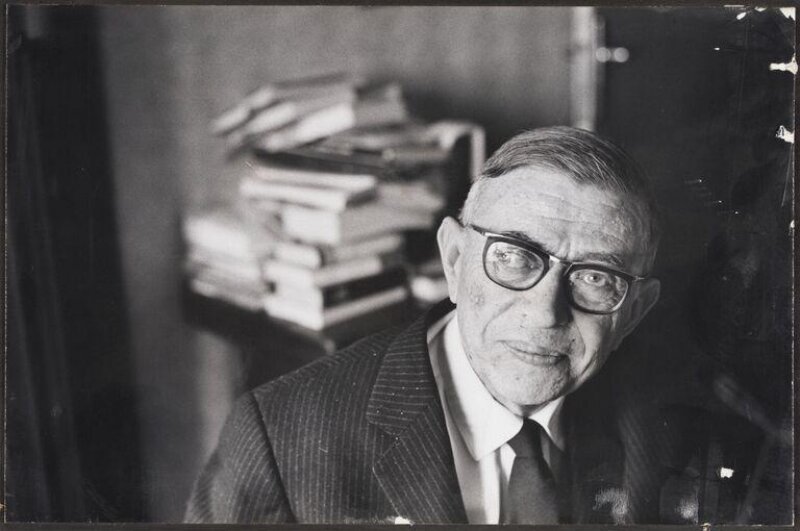
Jean-Paul Sartre
1905–1980
French existentialist philosopher (1905–1980)
Talk to Jean-Paul Sartre
Have a conversation with this historical figure through AI
Biography
Jean-Paul Charles Aymard Sartre was a French philosopher, playwright, novelist, screenwriter, political activist, biographer, and literary critic, considered a leading figure in 20th-century French philosophy and Marxism. Sartre was one of the key figures in the philosophy of existentialism. His work has influenced sociology, critical theory, post-colonial theory, and literary studies. He was awarded the 1964 Nobel Prize in Literature despite attempting to refuse it, saying that he always declined official honors and that "a writer should not allow himself to be turned into an institution."
Timeline
The story of Jean-Paul Sartre, told in moments.
Publishes Nausea. A novel about a man who becomes physically ill from the sheer meaninglessness of existence. It doesn't sell well. He teaches philosophy in Le Havre and Paris, wears dirty clothes, and drinks too much.
Publishes Being and Nothingness. 700 pages of existentialist philosophy written while Paris is under German occupation. 'Existence precedes essence.' You aren't born with a purpose. You build one. The Left Bank intellectuals make it their gospel.
Declines the Nobel Prize in Literature. Sends a letter explaining he's always refused official honors. The prize is worth 273,000 kronor. He'd also turned down the Legion of Honour. He later admits he could have used the money.
Dies of pulmonary edema in Paris at 74. Fifty thousand people follow his coffin to Montparnasse Cemetery. He and Simone de Beauvoir never married despite 50 years together. She'd asked. He said no. They're buried in the same grave.
In Their Own Words (20)
Our responsibility is much greater than we might have supposed, because it involves all mankind.
Existentialism and Human Emotions (1957), 1957
To choose this or that is to affirm at the same time the value of what we choose, because we can never choose evil. We always choose the good, and nothing can be good for us without being good for all.
Existentialism and Human Emotions (1957), 1957
Fascism is not defined by the number of its victims, but by the way it kills them.
"On the Execution of Julius and Ethel Rosenberg," Libération (22 June 1953), 1953
What then did you expect when you unbound the gag that muted those black mouths? That they would chant your praises? Did you think that when those heads that our fathers had forcibly bowed down to the ground were raised again, you would find adoration in their eyes?
"Orphée Noir (Black Orpheus)" preface, Anthologie de la Nouvelle Poésie Nègre et Malgache (1948), 1948
Admit it, it is your youth that you regret, more even than your crime; it is my youth you hate, even more than my innocence.
Electra to her mother Clytemnestra, Act 1, 1943
Artifacts (15)
More from the Early 20th Century


Explore what happened on the days that shaped Jean-Paul Sartre's life. Today In History connects historical figures with the events, births, and deaths that defined their era. Browse all historical figures or explore today's events.