
Today In History logo TIH
Calvin Coolidge

Historical Figure

Calvin Coolidge

1872–1933

President of the United States from 1923 to 1929

Victorian Era

Character Profile

The Quiet One

Calvin Coolidge

Calvin Coolidge’s wife Grace once told a dinner guest that she’d bet a friend she could get the President to say more than two words over the course of the meal. Coolidge looked up from his plate, assessed the situation, and said: “You lose.” Grace loved him for the rest of his life.

H.L. Mencken called him “the greatest man who ever came out of Plymouth Notch, Vermont.” Dorothy Parker, told that Coolidge had died, said: “How can they tell?” Will Rogers said: “He didn’t do nothing, but that’s what people wanted done.” Three of the sharpest wits in American history, all circling the same mystery: how do you make silence into a political tool, and how do you make it for thirty years?

Coolidge understood something most politicians never learn. The desire to fill silence is a weakness in the person who has it — not in the silence. If you could simply refuse to feel the pressure to speak, you could let other people talk themselves into your preferred outcome. He did this in cabinet meetings. He did this with foreign ambassadors. He did this, famously, with a woman at a White House dinner who told him she had bet her husband she could get more than two words out of him — “You lose” — and then with a different woman who pestered him for twenty minutes about nothing, at the end of which Coolidge said only: “Madam, you wouldn’t mind answering a question for me?” She said she’d be delighted. He said: “Why have you been talking to me for the last twenty minutes?”

He wasn’t shy. He wasn’t depressed. Close observers said he was watching. Always watching. He once told a friend: “Four-fifths of all our troubles in this life would disappear if we would only sit down and keep still.” He meant it as policy advice. He meant it as personal advice. He meant it as theology. The presidency of the 1920s was, in his view, a job that most of the time called for absence — and Coolidge answered the call. He took long naps. He vacationed for three months at a stretch. When he decided not to seek re-election in 1928, he announced it in ten words on a typewritten slip handed to reporters: “I do not choose to run for President in nineteen twenty-eight.” No press conference. No explanation. He then watched Herbert Hoover win the election, watched Hoover inherit the stock market crash, and told friends, privately, that he’d timed it about right.

Talk to Coolidge and prepare to sit with pauses that last longer than you’ve sat with pauses before. He’s not forming a sentence. He’s deciding whether the sentence is worth the cost of saying it. Most of the time, it isn’t. When he speaks, you’ll wish you’d been recording. When he doesn’t, you’ll realize — later, somewhere around 2 AM — that you learned more from what he didn’t say than from anything you’ve ever been told directly.


Three questions to start with:

  • Grace’s dinner-party bet. “You lose.” Were you playing along, or did you genuinely not realize it was a joke until later?
  • “Four-fifths of all our troubles would disappear if we would only sit down and keep still.” What’s the one-fifth you couldn’t sit still for?
  • You left office nine months before the 1929 crash. Did you see it coming, or were you just tired?
Hear Their Voice

Original recordings and AI voice

Original Speech

"July 4th Speech on Taxes" — 1920

AI Voice Clone

Generated by Today in History

Talk to Calvin Coolidge

Have a conversation with this historical figure through AI

Biography

Calvin Coolidge was the 30th president of the United States, serving from 1923 to 1929. A Republican lawyer from Massachusetts, he previously served as the 29th vice president from 1921 to 1923, under President Warren G. Harding, and as the 48th governor of Massachusetts from 1919 to 1921. Coolidge gained a reputation as a small-government conservative, with a taciturn personality and dry sense of humor that earned him the nickname "Silent Cal".

Read more on Wikipedia

Timeline

The story of Calvin Coolidge, told in moments.

1872 Birth

Born on Independence Day in Plymouth Notch, Vermont. The only U.S. president born on the Fourth of July. His father was a farmer and storekeeper.

1919 Event

Elected Governor of Massachusetts. Made national headlines by breaking the 1919 Boston Police Strike, declaring "There is no right to strike against the public safety by anybody, anywhere, any time."

1923 Event

Sworn in as 30th President at 2:47 a.m. in his father's Vermont farmhouse by lamplight. His father, a notary public, administered the oath. Harding had died hours earlier.

1928 Event

Chose not to run for re-election with the famously terse announcement: "I do not choose to run for President in 1928." No explanation. The Roaring Twenties roared on without him.

1933 Death

Died of a heart attack at his Northampton home at 60. Found by his wife on the bedroom floor. The Great Depression had wiped out the prosperity he'd presided over.

In Their Own Words (20)

Well, they’re going to elect that Stupid Hoover, and he’s going to have some trouble. He’s going to have to spend money, but it won’t be enough. Then the Democrats will come in. But they don’t know anything about money.

To Secret Service agent Edmund Starling, as quoted in The Forgotten Depression: 1921: The Crash That Cured Itself (2014), by James Grant, 2014

Wherever we look, the work of the chemist has raised the level of our civilization and has increased the productive capacity of our nation.

As quoted in Sid Meier's Civilization V (2010)., 2010

There is no substitute for a militant freedom. The only alternative is submission and slavery.

The Price of Freedom: Speeches and Addresses, Coolidge, The Minerva Group (2001), p. 159, 2001

In other periods of depression it has always been possible to see some things which were solid and upon which you could base hope, but as I look about, I now see nothing to give ground for hope — nothing of man. But there is still religion, which is the same yesterday, today, and forever. That continues as a solid basis for hope and courage.

Conversation with Charles Andrews (1 January 1933), quoted in Coolidge: An American Enigma (2000)., 2000

I feel I no longer fit in with these times.

To a friend, shortly before Coolidge's death, as quoted in Coolidge: An American Enigma (1998), by Robert Sobel, Regnery Publishing, p. 410., 1998

Artifacts (15)

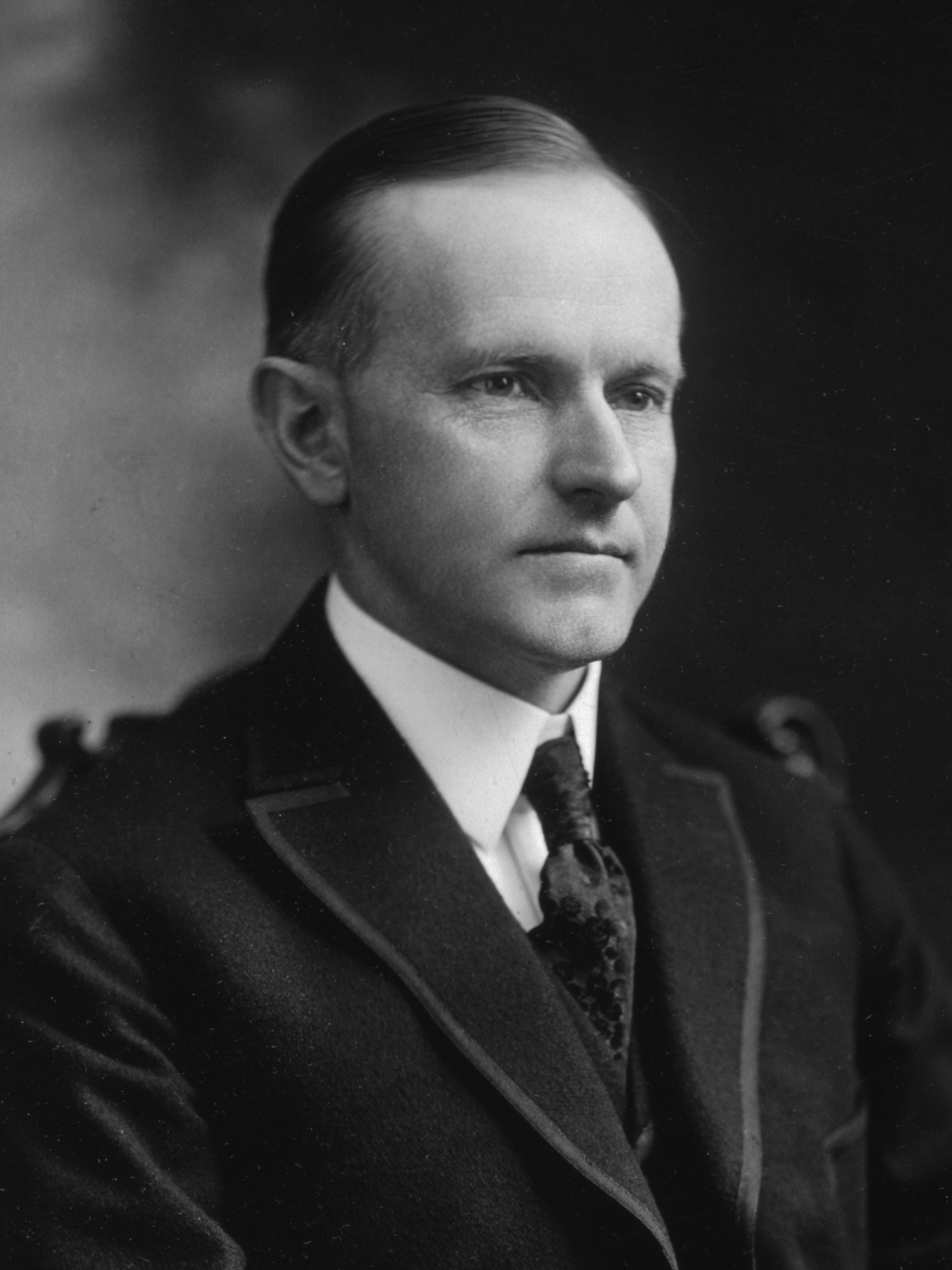
Calvin Coolidge (cropped & Greyscaled)

Notman Studio, Boston. Restoration by User:Adam Cuerden

1919
commons View

Calvin Coolidge and William Howard Taft

Harris & Ewing Studio, active 1905 - 1977

1923 · Gelatin silver print
Smithsonian View

Calvin Coolidge

Samuel Johnson Woolf

1923 · Charcoal and chalk on paper
Smithsonian View

Mrs. Calvin Coolidge

Moses Wainer Dykaar, born Vilna, Russia 1884-died New York City 1933

before 1927 · marble
Smithsonian View

Calvin Coolidge

Doris Ulmann

c. 1924 · Platinum print
Smithsonian View

Bookplate for Calvin Coolidge

Timothy Cole

n.d. · Engraving on paper
aic View

President Calvin Coolidge, head-and-shoulders portrait, facing right LCCN91784345

Miscellaneous Items in High Demand, PPOC, Library of Congress

1923
commons View

The Autobiography of Calvin Coolidge

CONTENTS: Scenes of My Childhood Seeking an Education The Law and Politics In National Politics On Entering and Leaving the Presidency Some of the Duties of the President Why I Did Not Choose to Run

1929

The Quotable Calvin Coolidge: Sensible Words for a New Century

President Calvin Coolidge has only recently begun to get the reappraisal he deserves.

2001

State of the Union Addresses

Reproduction of the original: State of the Union Addresses by Calvin Coolidge

2018
Speeches Read Talk

The Autobiography of Calvin Coolidge

Amity Shlaes reclaimed a misunderstood president with her bestselling biography Coolidge. Now she presents an expanded and annotated edition of that president’s masterful memoir. The Autobiography of...

2021

Fourth State of the Union Address

In his Fourth State of the Union Address, President Calvin Coolidge reflects on the socio-economic fabric of early 20th-century America with a focus on labor rights and racial equality. Delivered in...

2022

Have faith in Massachusetts; 2d ed: A Collection of Speeches and Messages

DigiCat Publishing presents to you this special edition of "Have faith in Massachusetts; 2d ed" (A Collection of Speeches and Messages) by Calvin Coolidge. DigiCat Publishing considers every written...

2022

State of the Union Addresses of Calvin Coolidge: in large print

Reproduction of the original.

2023
Speeches Read Talk

Have Faith in Massachusetts: A Collection of Speeches and Messages

1919

More from the Victorian Era

Explore what happened on the days that shaped Calvin Coolidge's life. Today In History connects historical figures with the events, births, and deaths that defined their era. Browse all historical figures or explore today's events.