Today In History
March 14 in History
Your birthday shares the stage with stories that shaped the world. Born on this day: Albert Einstein, Mike Lazaridis, and S. Truett Cathy.

Einstein Born: Physics Gains Its Greatest Mind
Albert Einstein was born in Ulm, Germany, on March 14, 1879, to a family that worried about his development. He did not speak fluently until age nine. His teachers considered him slow. His school in Munich recommended he leave because his attitude was disruptive. Nothing about his early life suggested he would become the most famous scientist in human history. Einstein's academic career began unremarkably. He graduated from the Zurich Polytechnic in 1900 but could not secure a teaching position at any university, partly because his professors found him insubordinate. He took a job as a patent clerk in Bern, Switzerland, evaluating patent applications for electromagnetic devices. The position left his evenings free for physics. In 1905, working alone without access to an academic laboratory or research colleagues, Einstein published four papers that transformed physics. The first explained the photoelectric effect using quantum theory, work that would earn him the 1921 Nobel Prize. The second provided mathematical proof that atoms exist by analyzing Brownian motion. The third introduced special relativity, demolishing the Newtonian concept of absolute space and time. The fourth derived the mass-energy equivalence formula E=mc2, establishing that matter and energy are interchangeable. The general theory of relativity followed in 1915, describing gravity not as a force but as a curvature of spacetime caused by mass and energy. Arthur Eddington's 1919 solar eclipse observations confirmed Einstein's prediction that light bends around massive objects, turning Einstein into an international celebrity overnight. Einstein fled Nazi Germany in 1933 and settled at the Institute for Advanced Study in Princeton, New Jersey. He signed the letter to President Roosevelt in 1939 warning that Germany might develop an atomic bomb, helping to initiate the Manhattan Project, though he played no direct role in weapons development. He spent his final decades searching for a unified field theory that eluded him, and died in Princeton on April 18, 1955, at age seventy-six.
Famous Birthdays
1879–1955
Mike Lazaridis
b. 1961
S. Truett Cathy
1921–2014
Taylor Hanson
b. 1983
Isabella Beeton
1836–1865
Jerry Greenfield
b. 1951
Jona Lewie
b. 1947
Paul Ehrlich
1854–1915
Wacław Sierpiński
d. 1969
William Clay Ford
b. 1925
Historical Events
The night before they killed Julius Caesar, the conspirators nearly decided to kill Mark Antony too. On the evening of March 14, 44 BC, Gaius Cassius Longinus and Publius Servilius Casca argued that Antony, Caesar's most loyal and powerful ally, should die alongside the dictator. Leaving him alive, they warned, was leaving the revolution incomplete. Marcus Junius Brutus overruled them. Brutus insisted the assassination must appear as a principled act of tyrannicide, not a political massacre. Killing Caesar could be justified as defending the Republic from a would-be king. Killing his lieutenant would look like a coup. The conspirators needed the Senate and the Roman public on their side, and a bloodbath would turn sympathy against them. The debate exposed the fundamental tension within the conspiracy. Cassius, a hardened military commander, understood that political survival required eliminating all potential enemies. Brutus, a philosopher and idealist, believed that the righteousness of their cause would speak for itself. Decimus Junius Brutus, the third key conspirator, who was close enough to Caesar to convince him to attend the Senate the next day, appears to have sided with Marcus Brutus on the question. The decision proved catastrophic. After Caesar's assassination on the Ides of March, Antony seized control of Caesar's papers, fortune, and political legacy. He delivered a funeral oration that turned the Roman mob against the conspirators, forcing Brutus and Cassius to flee Rome within weeks. Antony formed the Second Triumvirate with Octavian and Lepidus, and their combined forces destroyed the Republican armies at the Battle of Philippi in 42 BC, where both Brutus and Cassius died. Every strategic disaster that followed for the conspirators traced back to this single decision made the night before the assassination. Cassius understood his enemy better than Brutus understood his own idealism.
Eli Whitney patented the cotton gin on March 14, 1794, a deceptively simple machine that separated cotton fibers from their seeds fifty times faster than human hands could manage. The invention solved a bottleneck that had limited cotton production to a minor Southern crop. Within a decade, it had transformed cotton into America's most valuable export and revived a system of slavery that had been slowly declining. The problem Whitney solved was specific to short-staple cotton, the variety that grew across most of the American South. Long-staple cotton, grown in coastal areas, had smooth seeds that separated easily, but short-staple cotton had sticky green seeds that clung to the fibers and required hours of tedious hand labor to remove. Whitney's gin used rotating wire teeth to pull cotton fibers through a mesh screen while brushes swept the cleaned cotton off the teeth. Whitney built his first prototype in 1793 on a Georgia plantation belonging to Catherine Greene, the widow of Revolutionary War general Nathanael Greene. He traveled to Philadelphia to secure a patent and returned to Georgia to begin manufacturing, but the machine was so simple that plantation owners could easily copy it. Whitney spent years in patent litigation that consumed most of his profits. He eventually abandoned the cotton gin business and turned to manufacturing muskets for the U.S. government, where he pioneered the use of interchangeable parts. The gin's economic impact was staggering. American cotton production exploded from roughly 3,000 bales in 1790 to 73,000 bales in 1800 and over 4 million bales by 1860. Cotton became the foundation of the Southern economy, accounting for over half of all U.S. exports by the 1850s. British textile mills depended on it, giving the South leverage that slaveholders believed would protect their political interests. The machine that made cotton profitable made slavery profitable, and the wealth it generated made the Civil War inevitable.
The Soviet Congress of People's Deputies elected Mikhail Gorbachev as the first executive president of the Soviet Union on March 14, 1990, creating a powerful new office that was supposed to stabilize the reforming communist state. The position gave Gorbachev authority independent of the Communist Party for the first time, but the country he now led was already fracturing along national, economic, and ideological lines that no amount of presidential power could hold together. Gorbachev had introduced glasnost and perestroika beginning in 1985, policies intended to modernize the Soviet system through transparency and economic restructuring while preserving the Communist Party's leading role. By 1990, those reforms had unleashed forces he could not control. Lithuania had declared independence on March 11, just three days before Gorbachev's election as president. Nationalist movements were surging in the Baltic states, the Caucasus, Ukraine, and Central Asia. The new presidential office was designed to give Gorbachev a power base outside the party apparatus, which was increasingly divided between hardline conservatives who wanted to reverse reforms and radical reformers who wanted to accelerate them. The Congress voted 1,329 to 495 to create the presidency, but Gorbachev was the only candidate, and the absence of a popular mandate weakened his legitimacy from the start. Gorbachev used his presidential powers to pursue the New Union Treaty, an attempt to renegotiate the relationship between Moscow and the Soviet republics on a voluntary federal basis. The negotiations dragged through 1990 and into 1991 as republic after republic declared sovereignty. Boris Yeltsin's election as president of the Russian republic in June 1991 created a rival power center that further eroded Gorbachev's authority. The August 1991 coup attempt by hardliners, intended to reverse the dissolution, instead accelerated it. Gorbachev resigned as president on December 25, 1991, and the Soviet Union ceased to exist the following day. The presidency Gorbachev created outlived the country it was designed to save by exactly twenty-one months.
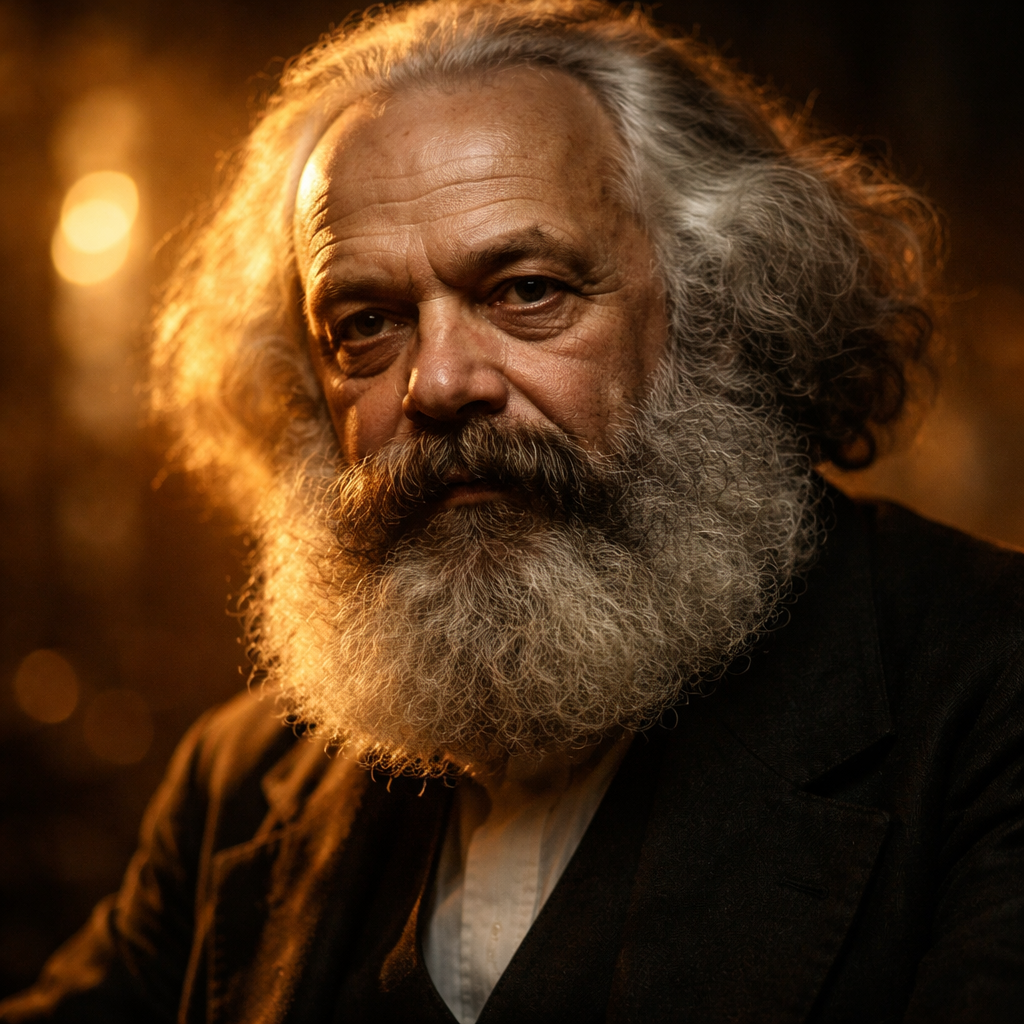
Eleven people attended the funeral. Karl Marx died in his armchair on March 14, 1883, at his home in London, a stateless exile who had been expelled from Germany, France, and Belgium. He was sixty-four, plagued by boils, liver disease, and chronic bronchitis. His life's work, Das Kapital, had sold poorly. His family had lived in grinding poverty for decades, surviving on loans from Friedrich Engels and occasional journalism. Marx had spent his intellectual life in the reading room of the British Museum, where he developed a theory of history and economics that would reshape the twentieth century more than any other body of thought. The Communist Manifesto, written with Engels in 1848, argued that all of human history was the story of class struggle and predicted that capitalism would inevitably destroy itself through its own internal contradictions. Das Kapital, published in three volumes between 1867 and 1894 (the final two volumes edited posthumously by Engels), provided the theoretical framework. Marx argued that capitalism extracted surplus value from workers, that the accumulation of capital concentrated wealth in fewer and fewer hands, and that periodic crises of overproduction would eventually radicalize the working class into revolutionary action. During his lifetime, Marx's ideas influenced European socialist movements but remained marginal in mainstream politics. He feuded bitterly with rival socialists, was expelled from the International Workingmen's Association he helped found, and spent his final years in declining health, unable to complete his planned additional volumes of Das Kapital. Within forty years of his death, a revolution fought in his name would topple the Russian Empire. Within seventy years, governments claiming to follow his theories controlled a third of the world's population. Marxism shaped the ideologies of China, Cuba, Vietnam, and dozens of liberation movements across Africa, Asia, and Latin America. The obscure exile who died in a London armchair became the most consequential political philosopher since the Enlightenment.
Gilbert and Sullivan's The Mikado opened at the Savoy Theatre in London on March 14, 1885, and the audience loved it so thoroughly that the opera ran for 672 consecutive performances, the longest initial run of any work of musical theater up to that point. The show earned the modern equivalent of millions of pounds and cemented the partnership between librettist W.S. Gilbert and composer Arthur Sullivan as the most successful creative collaboration in Victorian entertainment. The Mikado was set in Japan but satirized British society. Gilbert used the fictional town of Titipu and its absurd penal code as a vehicle for mocking Victorian bureaucracy, class pretension, and legal hypocrisy. The Lord High Executioner, Ko-Ko, has been condemned to death for flirting but promoted to executioner because, as the logic goes, he cannot execute himself until he has executed someone else. Every character operates within a system of rules that is simultaneously rigid and nonsensical. The opera arrived during a craze for Japanese art and culture that swept Britain in the 1880s, triggered by the opening of a Japanese exhibition in London. Gilbert seized on the aesthetic novelty while keeping the satire entirely British. Sullivan's score matched the wit of the libretto with music that ranged from mock-operatic grandeur to genuinely beautiful melodic writing. "Three Little Maids from School" and "A Wandering Minstrel I" became immediately popular. The Mikado has been performed more often than any other Gilbert and Sullivan work and ranks among the most frequently staged operatic works in the English language. It has been adapted for film, television, and stage in countless productions worldwide. The D'Oyly Carte Opera Company, which produced all the original Gilbert and Sullivan operas, performed The Mikado continuously for over a century. The work proved that satire, wrapped in enough charm and melody, can entertain audiences who would resist the same criticisms delivered as argument.
The king lost to his own cousins in a single afternoon. At Mogyoród, Géza and Ladislaus faced Solomon—not a foreign invader, but their own blood, the crowned King of Hungary—and crushed his forces so thoroughly he had to abandon his throne. Solomon fled to the western borderlands with whatever loyalists remained. For the next thirteen years, he'd wage a desperate guerrilla campaign trying to reclaim what he'd lost in those few hours. Géza took the crown immediately, and when he died four years later, Ladislaus succeeded him—the same Ladislaus who'd be canonized as Saint Ladislaus I, Hungary's warrior-saint. The battle didn't just change rulers; it proved that medieval kingship wasn't about divine right or legitimacy. It was about who could hold the field.
The fishermen of Chioggia betrayed their mother city. In 1381, this tiny Venetian lagoon town — barely three miles from the Doge's Palace — signed a secret pact with Zadar and Trogir, Dalmatian cities across the Adriatic that Venice had brutally conquered. They'd been at war with Venice just two years earlier, nearly strangling the republic by blockading its lagoon. Now they were plotting again. The alliance festered for three decades until 1412, when Šibenik joined and the conspiracy finally collapsed. But Venice never forgot. The city that controlled Mediterranean trade for centuries couldn't control the fishermen who lived in its shadow.
Henry of Navarre commanded his cavalry charge at Ivry with white plumes streaming from his helmet, shouting to his outnumbered Huguenot troops: "Follow my panache!" The Catholic League's 20,000 soldiers should've crushed his 11,000 Protestant fighters, but the Duc de Mayenne's mercenaries broke ranks and fled when Henry's horsemen smashed their flanks. Four thousand Catholics died in the rout. But here's the twist: Henry couldn't march on Paris afterward because the Spanish reinforced the city, dragging out the religious wars four more years. The Protestant king who won at Ivry would eventually convert to Catholicism anyway, declaring "Paris is worth a Mass" to finally claim his throne in 1593.
The captain scuttled his own ship rather than let the English take her intact. At Ronas Voe in the Shetlands, the Dutch East India Company vessel Wapen van Rotterdam ran aground while fleeing English warships, and her commander made a brutal calculation: destroy everything. Up to 300 Dutch crew and soldiers died in the chaos—some drowned, others killed in the fighting, many trapped below deck as the ship was deliberately wrecked. The English captured what remained anyway. But here's the thing: this wasn't even a major naval battle, just one merchant vessel's desperate final hours in a war that most people have never heard of. Three hundred men dead for a footnote.
They blindfolded him with his own handkerchief, then shot him on the quarterdeck. Admiral John Byng became the only British admiral ever executed for failing to "do his utmost" in battle—he'd retreated from Minorca after a messy engagement with the French, losing Britain's Mediterranean stronghold. George II wanted him pardoned, but Parliament, desperate for a scapegoat after years of military humiliations, wouldn't budge. Voltaire watched the whole affair from France and immortalized it in *Candide*: the British execute admirals "to encourage the others." The phrase stuck because it captured something true—Byng didn't lose because he was a coward, but because the Admiralty needed someone to blame for their own failures.
The Spanish governor who saved the American Revolution wasn't even trying to help it. Bernardo de Gálvez attacked Fort Charlotte in Mobile with 1,400 troops—Spanish regulars, free Black militia, and Choctaw warriors—because Britain threatened his own territory. The British commander Elias Durnford surrendered after a two-week siege, and suddenly the entire Gulf Coast belonged to Spain. This mattered more than anyone realized: with British forces pinned down defending Florida and the Caribbean against Spanish attacks, they couldn't reinforce Cornwallis in the north. Washington's path to Yorktown got clearer because a Spanish colonial administrator 1,200 miles away wanted to protect New Orleans. American independence was a team effort, and some teammates didn't even know they were playing.
McKinley's Treasury Secretary had to buy gold from J.P. Morgan just three years earlier to prevent the dollar's collapse. Now Congress was locking America to gold permanently. The Gold Standard Act made every paper dollar redeemable for exactly 1.5 grams of gold—no exceptions. William Jennings Bryan had lost two presidential campaigns railing against this moment, warning farmers it'd strangle them with deflation. He was right. Within three decades, the rigid system couldn't handle the Depression's chaos. Roosevelt abandoned it in 1933, and Nixon finally killed it completely in 1971. The "eternal" standard lasted barely seventy years—shorter than a human lifetime.
The Colombian Senate had every reason to say yes—$10 million upfront, plus $250,000 annually for a canal that would transform global trade. But they rejected it anyway. The U.S. offer felt like extortion, the terms insulting to their sovereignty. Within months, Theodore Roosevelt backed a Panamanian revolution, and Panama—suddenly independent—signed an identical treaty just two weeks after breaking from Colombia. Colombia lost both the canal and a chunk of its territory. Sometimes the cost of saying no isn't just the deal you refuse—it's the country you lose.
The oil shot 200 feet into the air and didn't stop. For 18 months, the Lakeview Gusher near Bakersfield hemorrhaged 9 million barrels of crude—enough to fill 378 Olympic swimming pools—creating a black lake that stretched across the valley floor. Drillers couldn't cap it. The pressure was too immense, the technology too primitive. By the time it finally ran dry in September 1911, the well had vomited out more oil than California produced in an entire year, most of it soaking uselessly into the earth or evaporating into the sky. America's biggest oil strike became its most spectacular waste.
The crew of the German light cruiser SMS Dresden scuttled their ship at Cumberland Bay, Robinson Crusoe Island, off the Chilean coast on March 14, 1915, ending the last raider from Admiral Maximilian von Spee's Pacific Squadron and closing one of the most dramatic naval chases of the First World War. The Dresden had been the only German warship to escape the Battle of the Falkland Islands on December 8, 1914, when a British squadron under Vice Admiral Doveton Sturdee destroyed the bulk of von Spee's squadron, sinking the Scharnhorst, Gneisenau, Leipzig, and Nurnberg. Von Spee himself went down with the Scharnhorst. The Dresden survived because her superior speed allowed her to outrun the pursuing British cruisers in deteriorating weather. For three months after the Falklands, the Dresden evaded British patrols in the channels and fjords of southern Chile, resupplying from German merchant ships and sympathetic Chilean contacts. Her captain, Fritz Ludecke, hoped to resume commerce raiding in the Pacific, but the ship's engines were in poor condition, coal was increasingly difficult to obtain, and the British had dispatched multiple cruisers to hunt her down. On March 9, 1915, the cruisers HMS Kent and HMS Glasgow located the Dresden at anchor in Cumberland Bay, a sheltered inlet on Mas a Tierra (now Robinson Crusoe Island). The bay lay within Chilean territorial waters, and Ludecke attempted to invoke Chile's neutrality. The British ignored the protest and opened fire. After taking several hits, Ludecke ordered the sea cocks opened and the ship scuttled. The crew abandoned ship and were interned by Chilean authorities. The sinking generated a diplomatic incident between Britain and Chile over the violation of neutral waters, but the British calculated that eliminating the last German raider in the Pacific was worth the diplomatic cost. The destruction of the Dresden ended Germany's surface naval presence in the Pacific and South Atlantic for the remainder of the war.
Fun Facts
Zodiac Sign
Pisces
Feb 19 -- Mar 20
Water sign. Compassionate, intuitive, and artistic.
Birthstone
Aquamarine
Pale blue
Symbolizes courage, serenity, and clear communication.
Next Birthday
--
days until March 14
Quote of the Day
“Everybody is a genius. But if you judge a fish by its ability to climb a tree, it will live its whole life believing that it is stupid.”
Share Your Birthday
Create a beautiful birthday card with events and famous birthdays for March 14.
Create Birthday CardExplore Nearby Dates
Popular Dates
Explore more about March 14 in history. See the full date page for all events, browse March, or look up another birthday. Play history games or talk to historical figures.