

Historical Figure
Nicolaus Copernicus
d. 1543
Mathematician and astronomer (1473–1543)
Talk to Nicolaus Copernicus
Have a conversation with this historical figure through AI
Biography
Nicolaus Copernicus was a Renaissance polymath who formulated a model of the universe that placed the Sun rather than Earth at its center. The publication of Copernicus's model in his book De revolutionibus orbium coelestium, just before his death in 1543, was a major event in the history of science, triggering the Copernican Revolution and making a pioneering contribution to the Scientific Revolution. Though a similar heliocentric model had been developed eighteen centuries earlier by Aristarchus of Samos, an ancient Greek astronomer, Copernicus likely arrived at his model independently.
Timeline
The story of Nicolaus Copernicus, told in moments.
In Bologna, assisting the astronomer Domenico Maria Novara, he observes the Moon occult the star Aldebaran. It's a small observation. But it confirms what he's starting to suspect: Ptolemy's model of the Moon has errors. Something doesn't add up.
Circulates an unsigned manuscript called the Commentariolus among friends. Forty handwritten pages. The Sun is at the center. The Earth moves. He won't publish the full argument for another 29 years.
Derives an early quantity theory of money. Two years later, he formulates an economic principle later called Gresham's law: bad money drives out good. He's a canon lawyer, physician, governor, diplomat, and economist. Astronomy is technically a side project.
Dies in Frombork at 70. Legend says a printed copy of De revolutionibus is placed in his hands on his deathbed. The book argues the Earth revolves around the Sun. It takes a century for the idea to win. The Church doesn't remove it from the Index of Forbidden Books until 1758.
Reburied with full honors in Frombork Cathedral, 467 years after his first burial. DNA from a tooth and a hair confirmed the identity. A black granite tombstone shows a model of the solar system. Golden sun at the center.
In Their Own Words (14)
Finally we shall place the Sun himself at the center of the Universe. All this is suggested by the systematic procession of events and the harmony of the whole Universe, if only we face the facts, as they say, "with both eyes open."
As quoted in The Copernican Revolution : Planetary Astronomy in the Development of Western Thought (1957) by Thomas S. Kuhn, 1957
If perchance there should be foolish speakers who, together with those ignorant of all mathematics, will take it upon themselves to decide concerning these things, and because of some place in the Scriptures wickedly distorted to their purpose, should dare to assail this my work, they are of no importance to me, to such an extent do I despise their judgment as rash. For it is not unknown that Lactantius, the writer celebrated in other ways but very little in mathematics, spoke somewhat childishly of the shape of the earth when he derided those who declared the earth had the shape of a ball. So it ought not to surprise students if such should laugh at us also. Mathematics is written for mathematicians to whom these our labors, if I am not mistaken, will appear to contribute something even to the ecclesiastical state the headship of which your Holiness now occupies.(Author's preface to de revolutionibus)
Translation as quoted in The Gradual Acceptance of the Copernican Theory of the Universe (1917) by Dorothy Stimson, p. 115, 1917
To know the mighty works of God, to comprehend His wisdom and majesty and power; to appreciate, in degree, the wonderful workings of His laws, surely all this must be a pleasing and acceptable mode of worship to the Most High, to whom ignorance cannot be more grateful than knowledge.
As quoted in Poland : The Knight Among Nations (1907) by Louis E. Van Norman, p. 290; also in The Language of God (2006) by Francis Collins, pp. 230-31, 1907
Those who devised the eccentrics seen thereby in large measure to have solved the problem of apparent motions with approximate calculations. But meanwhile they introduced a good many ideas which apparently contradict the first principles of uniform motion. Nor could they elicit or deduce from the eccentrics the principal consideration, that is, the structure of the universe and the true symmetry of its parts. On the contrary, their experience was just like someone taking from various places hands, feet, a head, and other pieces, very well depicted it may be, but for the representation of a single person; since these fragments would not belong to one another at all, a monster rather than a man would be put together from them.
Preface Letter to Pope Paul III, Tr. E. Rosen, De Revolutionibus Orbium Coelestium (1978) pp. 4-7., 1543
What indeed is more beautiful than heaven, which of course contains all things of beauty.
Introduction to Book 1, as quoted/translated by Edward Rosen, Nicholas Copernicus on the Revolutions (1978) ed. Jerzy Dobrzycki, Edward Rosen., 1543
Artifacts (15)


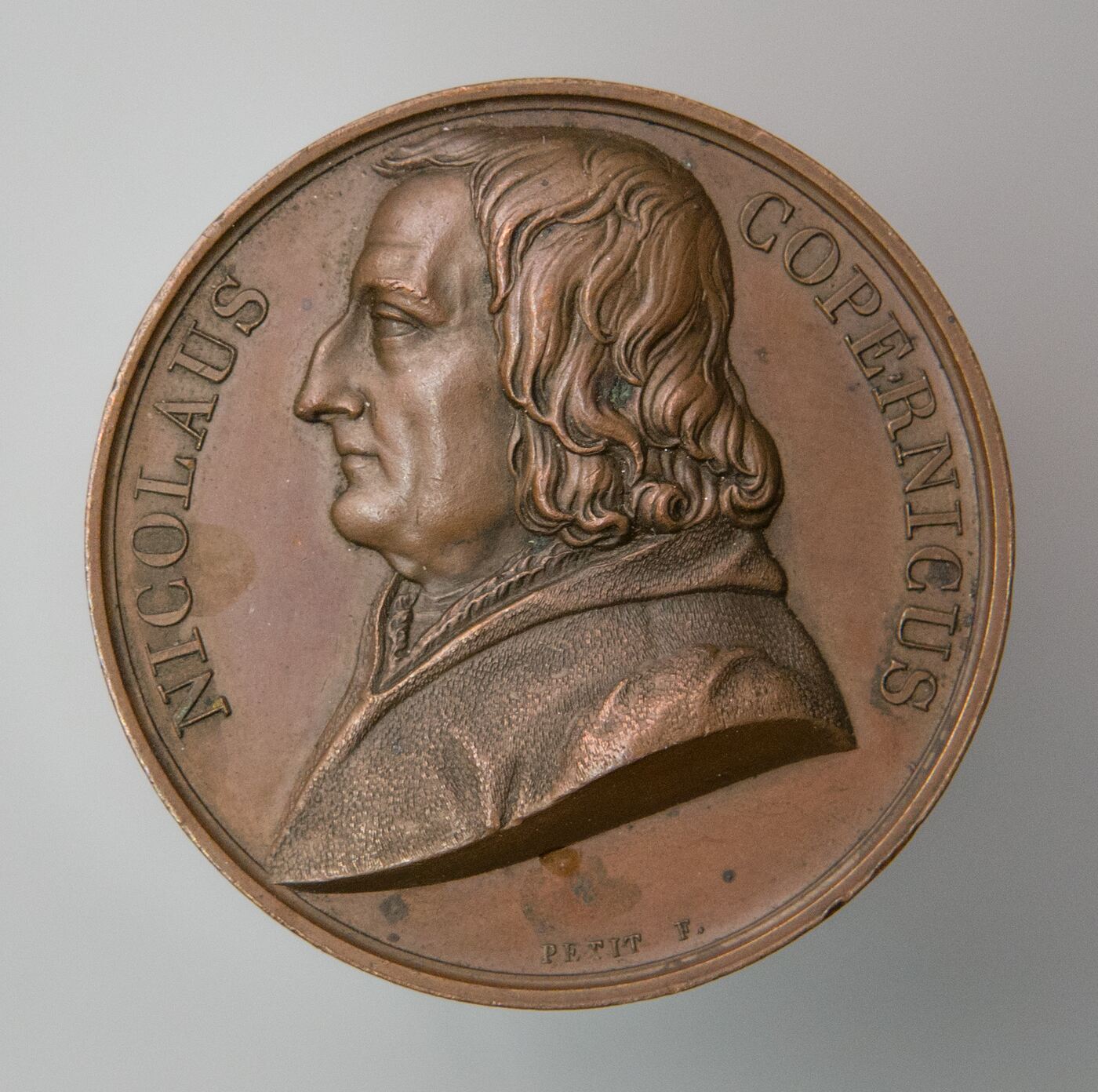


Nicolas Copernicus Polish cropped
Nicolas_Copernicus_Polish.JPG: Unknown painter (school of Cranach) derivative work: Craigboy (talk)
More from the Renaissance


Explore what happened on the days that shaped Nicolaus Copernicus's life. Today In History connects historical figures with the events, births, and deaths that defined their era. Browse all historical figures or explore today's events.