

Historical Figure
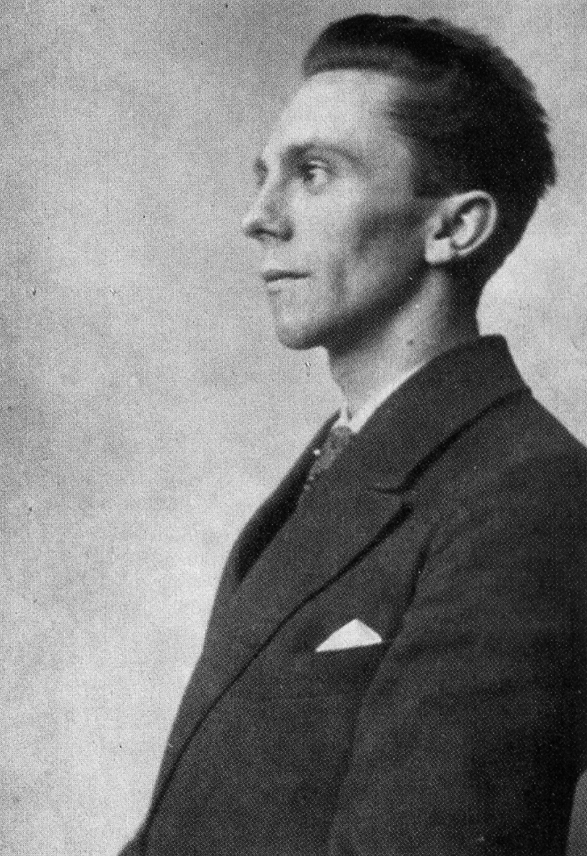
Joseph Goebbels
d. 1945
German Nazi propaganda minister (1897–1945)
What do you want Joseph Goebbels to say?
Sign up free to hear it.
Talk to Joseph Goebbels
Have a conversation with this historical figure through AI
Biography
Paul Joseph Goebbels was a German politician and philologist who was the Gauleiter of Berlin, chief propagandist for the Nazi Party, and then Reich Minister of Propaganda from 1933 until his suicide in 1945. He was one of Adolf Hitler's closest and most devoted followers and was known for his skills in public speaking and his virulent antisemitism which was evident in his publicly voiced views. He advocated for progressively harsher discrimination, including the extermination of Jews and other groups in the Holocaust.
Timeline
The story of Joseph Goebbels, told in moments.
Appointed Gauleiter of Berlin by Hitler. He's been in the party for two years. He discovers his real talent: propaganda. He starts a newspaper, Der Angriff, and stages street provocations designed to generate news coverage. He's small, clubfooted, and the opposite of the Aryan ideal he later promotes. He doesn't care. He's useful.
Named Reich Minister of Propaganda. Within months he controls every newspaper, radio station, film studio, and publishing house in Germany. He is particularly skilled with radio and cinema. He organizes the May 10 book burnings, where 25,000 volumes are incinerated in Berlin. Authors burned include Einstein, Freud, Hemingway, and H.G. Wells.
Kristallnacht. Goebbels gives a speech inciting violence against Jews after a German diplomat is shot in Paris. SA men and civilians smash 7,500 Jewish businesses and burn 267 synagogues across Germany and Austria. At least 91 Jews are killed. 30,000 are arrested and sent to concentration camps. The broken glass gives the pogrom its name.
Delivers the "Total War" speech at the Berlin Sportpalast. "Do you want total war?" he screams. The audience roars yes. He's been pushing Hitler for full economic mobilization for months. The speech is a masterpiece of manipulation. The 14,000 attendees have been hand-selected to guarantee the desired reaction.
Serves as Chancellor of Germany for one day after Hitler's suicide. Then he and his wife Magda poison their six children with cyanide in the bunker. The oldest is 12. The youngest is 4. Goebbels and Magda walk upstairs to the garden and kill themselves. He is 47.
In Their Own Words (20)
I think it's terrible that we [the Nazis] and the Communists are bashing each other's heads ... Where can we get together sometime with the leading Communists?
Attributed in The Rise and Fall of the Third Reich, William L. Shirer, Simon & Schuster, 2011, p. 126, 2011
I demand that the petty bourgeois Adolf Hitler be expelled from the Nazi Party.
As quoted in The Rise and Fall of the Third Reich: A History of Nazi Germany, William L. Shirer, New York: NY Simon & Schuster (2011), p. 127, first published 1960, 2011
The best propaganda is that which, as it were, works invisibly, penetrates the whole of life without the public having any knowledge of the propagandistic initiative.
Claudia Koonz , The Nazi Conscience, London and Cambridge, MA: Belknap Press of Harvard University (2004) p. 13. Quote from March, 1933., 2004
We and we alone [the Nazis] have the best social welfare measures. Everything is done for the nation. . . .The Jews are the incarnation of capitalism.
As quoted in I Will Bear Witness: A Diary of the Nazi Years, 1942-1945, Victor Klemperer, Vol. 2 , Random House, Inc. (2001) p. 317. Goebbels’ “Our Socialism” editorial was written on April 30, 1944., 2001
Therefore, Russia is our natural ally against the devilish temptation and corruption of the west.
“Das russische Problem“, (“The Russian Problem”), Nationalsozialistische Briefe (15 November 1925), Manfred Weißbecker, ‘“Wenn hier Deutsche wohnten…”. Beharrung und Veränderung im Rußlandbild Hitlers und der NSDAP, in: Volkmann H. (Hrsg.): Das Rußlandbild im Dritten Reich. Stuttgart (1994), p. 19-20. Quoted in Nazi Germany and the European East in the Twentieth Century, ed. Eduard Mühle, Chap. 4, “Nazi Germany and the European East,” Gerhand Hirschfeld, Berg Publishers, Oxford, UK (2003) p. 71., 1994
Artifacts (15)


Haus des Reichspropagandaministers Joseph Goebbels, Berlin-Mitte: Modellfoto
Böhmer & Petrich
Haus des Reichspropagandaministers Joseph Goebbels, Berlin-Mitte: Modellfoto
Böhmer & Petrich
Haus des Reichspropagandaministers Joseph Goebbels, Berlin-Mitte: Modellfoto
Böhmer & Petrich

Related Historical Figures


Explore what happened on the days that shaped Joseph Goebbels's life. Today In History connects historical figures with the events, births, and deaths that defined their era. Browse all historical figures or explore today's events.