

Historical Figure
Aung San Suu Kyi
b. 1945
Burmese politician (born 1945)
What do you want Aung San Suu Kyi to say?
Sign up free to hear it.
Hear the original recording — “Press Conference on Democracy in Burma” (2009) →
Talk to Aung San Suu Kyi
Have a conversation with this historical figure through AI
Biography
Aung San Suu Kyi is a Burmese politician, diplomat and author who served as State Counsellor of Myanmar and Minister of Foreign Affairs from 2016 to 2021. She has served as the general secretary of the National League for Democracy (NLD) since the party's founding in 1988 and was registered as its chairperson while it was a legal party from 2011 to 2023. She played a vital role in Myanmar's transition from military junta to partial democracy in the 2010s. She has been widely described as the de facto leader of Myanmar from 2016 to 2021. She was awarded the 1991 Nobel Peace Prize.
Timeline
The story of Aung San Suu Kyi, told in moments.
Returns to Burma to care for her dying mother and walks straight into a revolution. On August 26, she addresses 500,000 people at Shwedagon Pagoda. She's 43, has never given a political speech, and she commands the crowd completely.
Placed under house arrest by the military junta. She refuses an offer to leave the country in exchange for freedom. She'll spend 15 of the next 21 years confined to her lakeside home in Rangoon.
Awarded the Nobel Peace Prize while still under house arrest. Her sons, Alexander and Kim, accept on her behalf in Oslo. She donates the $1.3 million prize to establish a health and education trust for the Burmese people.
Her National League for Democracy wins a landslide election. She becomes State Counsellor, the de facto leader of Myanmar. The constitution, written by the military, bars her from the presidency because her children hold foreign passports.
Detained again in a military coup. Convicted on charges widely dismissed as politically motivated. Sentenced to 27 years. She's 75 and back where she started: under house arrest, refusing to leave.
In Their Own Words (20)
Our struggle for democracy has been carried out with a strong grasp on the principle of nonviolence. And also, we believe in the rule of law. So if you ask how do we propose to resolve all of these problems of violence between communities, between different ethnic groups, we've got to start with rule of law. People have to feel secure before they can start talking to one another. We cannot achieve harmony without security. People who feel threatened are not going to sit down and sort out their problems. So I would like to recommend, as the chair of the Rule of Law and Tranquility Committee -- don't forget that tranquility is also included -- that the government should look to rule of law. It is the duty of the government to make all our people feel secure, and it is the duty of our people to learn to live in harmony with one another.
Remarks by President Obama and Daw Aung San Suu Kyi of Burma in Joint Press Conference at Aung San Suu Kyi Residence in Rangoon, Burma on November 14, 2014, 2014
Democracy allows people to have different views, and democracy makes it also -- makes us also responsible for negotiating an answer for those views. [...] So we would like to -- it’s not just a matter of debating the case in parliament and winning Brownie points or Boy Scout points, or whatever they’re called. But it’s just a case of standing up for what we think our country needs. And we would like to talk to those who disagree with us. That, again, is what democracy is about. You talk to those who disagree with you; you don’t beat them down. You exchange views. And you come to a compromise, a settlement that would be best for the country. I’ve always said that dialogues and debates are not aimed at achieving victory for one particular party or the other, but victory for our people as a whole. [...] We want to build up a strong foundation for national reconciliation, which means reconciliation not just between the different ethnic groups and between different religious groups, but between different ideas -- for example, between the idea of military supremacy and the idea of civilian authority over the military, which is the foundation of democracy.
Remarks by President Obama and Daw Aung San Suu Kyi of Burma in Joint Press Conference at Aung San Suu Kyi Residence in Rangoon, Burma on November 14, 2014, 2014
Unless we are free from fear we will not be able to give our children the kind of future that we would like them to have.
2013
Security, freedom, dignity, if we had these three we could say that it has been worth while being born into this world and I would like all the young people of Burma and young people all over the world to be able to feel that it was right that they have been born into this world.
2013
We have to all come together and create unity out of diversity that the destiny that [we ]build will be one that is right not just for now but for generations to come.
2013
Artifacts (15)

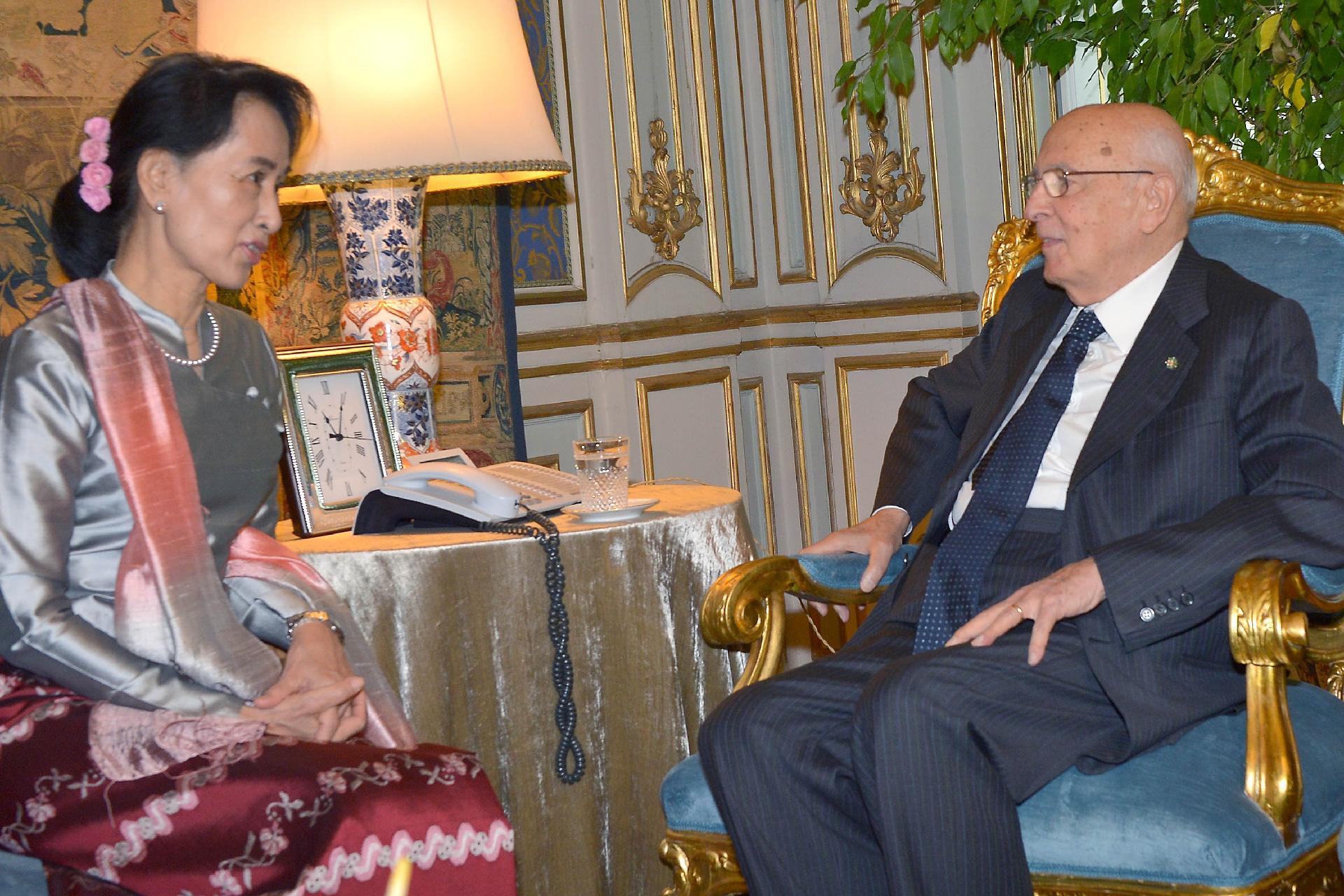
President Giorgio Napolitano during talks with Aung San Suu Kyi, Nobel Peace Prize

Il Presidente Giorgio Napolitano accoglie Aung San Suu Kyi, Premio Nobel per la Pace, al Quirinale
State Magazine January-February 1997- Iss 402 (IA sim state-magazine january-february-1997 402)
More from the Postwar


Explore what happened on the days that shaped Aung San Suu Kyi's life. Today In History connects historical figures with the events, births, and deaths that defined their era. Browse all historical figures or explore today's events.