

Soviets Encircle Stalingrad: Germany's Sixth Army Trapped
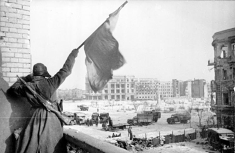
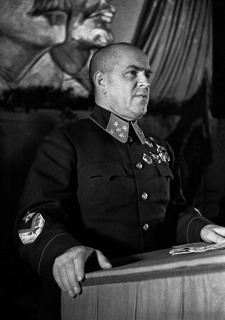
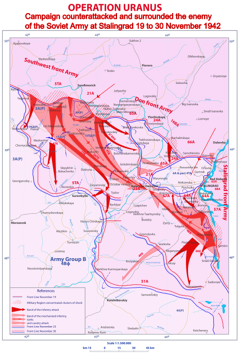
Soviet forces launched Operation Uranus, a massive pincer attack across the frozen steppes northwest and south of Stalingrad, and within four days encircled the German Sixth Army in a trap from which it would never escape. The counteroffensive turned the bloodiest battle of World War II decisively in the Soviet Union's favor and marked the moment when the strategic initiative on the Eastern Front shifted permanently away from Nazi Germany. The plan was conceived by Generals Georgy Zhukov and Aleksandr Vasilevsky during the worst weeks of the Stalingrad fighting, when German forces had pushed Soviet defenders into a few shattered blocks along the Volga riverbank. While the world's attention focused on the brutal street combat inside the city, the Soviet high command quietly assembled over one million fresh troops, 13,500 artillery pieces, and 900 tanks on the flanks of the German salient, hidden from German reconnaissance by strict operational security and bad weather. The attack struck the weakest points of the Axis line. The forces guarding the German flanks were not German at all but Romanian, Hungarian, and Italian divisions that were poorly equipped, undermotivated, and stretched thin across vast distances. On November 19, the Soviet blow fell on the Romanian Third Army northwest of Stalingrad. The next day, a second thrust hit the Romanian Fourth Army to the south. Both collapsed almost immediately. Soviet tank columns raced through the gaps, covering over 150 kilometers in three days. On November 23, the two pincers met at Kalach, closing a ring of steel around the German Sixth Army and parts of the Fourth Panzer Army. Approximately 290,000 Axis soldiers were trapped in a pocket roughly 50 kilometers wide.
November 19, 1942
84 years ago
Key Figures & Places
What Else Happened on November 19
Pope Urban VIII consecrated the current Saint Peter’s Basilica, finalizing a construction project that spanned over a century and involved masters like Michelan…
Ricimer didn't want the throne. He wanted something better — the man sitting on it. When Libius Severus was declared Western Roman Emperor in 461, Ricimer, the …
Arab forces shattered the Sassanian army at the Battle of Qadisiya, ending Persian control over Mesopotamia. This victory dismantled the Sassanian defense of th…
Urban II didn't command kings. He commanded crowds. At Clermont, he preached to thousands gathered in an open field — the church couldn't hold them — and report…
Christopher Columbus went ashore on an island he named San Juan Bautista on November 19, 1493, during his second voyage to the Americas, claiming it for the Spa…

A prisoner who had spent decades in French royal dungeons died in the Bastille in Paris, his face concealed behind a mask of black velvet, his identity one of t…
Talk to History
Have a conversation with historical figures who witnessed this era. Ask questions, explore perspectives, and bring history to life.