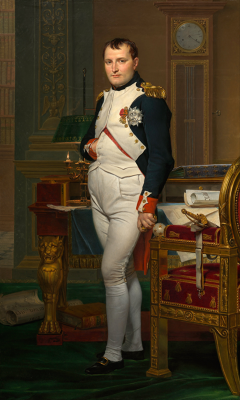
Napoleon Retreats from Moscow: Empire Crumbles
Napoleon Bonaparte led the largest army Europe had ever assembled into Russia in June 1812 and began leading its remnants back out on October 19, a retreat that would destroy his Grande Armée and crack the foundation of his empire. Of the roughly 685,000 soldiers who crossed the Niemen River into Russia, fewer than 100,000 would return alive. The Russian campaign became history's most devastating illustration of imperial overreach. Napoleon had invaded to force Czar Alexander I back into the Continental System, the trade embargo against Britain that was the cornerstone of French economic strategy. The Russians refused to fight the decisive battle Napoleon needed, instead withdrawing deeper into their own territory while burning crops, slaughtering livestock, and destroying anything of military value. The scorched-earth strategy denied the French army the supplies it depended on from captured territory. When the Grande Armée finally reached Moscow on September 14, they found the city largely abandoned and, within hours, engulfed in a fire that destroyed three-quarters of it over four days. Russian authorities had likely ordered the burning. Napoleon waited five weeks in the ruined city for a peace offer that never came. With winter approaching and his supply lines stretched across 600 miles of hostile territory, he ordered the retreat on October 19. The march home became a death march. Russian forces harassed the retreating columns relentlessly. Early winter storms brought freezing temperatures that killed thousands of soldiers weakened by starvation and disease. The crossing of the Berezina River in late November, under Russian artillery fire, killed an estimated 25,000. Soldiers ate their horses, then their boots, then nothing. Frostbite, typhus, and desertion devastated units that had been among the finest fighting forces in the world just months earlier. Napoleon abandoned the remnants of his army in December and raced ahead to Paris to organize a defense against the European coalition that was forming against him. The Russian disaster emboldened his enemies, led directly to the Wars of Liberation in 1813, and began the cascade of defeats that ended at Waterloo in 1815.
October 19, 1812
214 years ago
Key Figures & Places
What Else Happened on October 19
Hannibal Barca, the Carthaginian general who had terrorized Rome for fifteen years, met his match at Zama in 202 BC when a younger Roman commander named Scipio …
King Gaiseric led his Vandal forces into Carthage, seizing the city without a fight after years of relentless pressure on Roman North Africa. By capturing this …
King John succumbed to dysentery at Newark-on-Trent, ending a disastrous reign defined by the loss of French territories and the forced signing of the Magna Car…
Heidelberg University held its first lecture on October 18, 1386. The Elector Palatine founded it after a theological dispute got his scholars expelled from Par…
French forces recaptured Bordeaux on October 19, 1453, and the Hundred Years' War — which had actually lasted 116 years — finally ground to a close. England ret…
Bordeaux surrendered to French forces on this day, ending the Hundred Years' War. By losing its final foothold in Aquitaine, England retreated from the continen…
Talk to History
Have a conversation with historical figures who witnessed this era. Ask questions, explore perspectives, and bring history to life.