

Wuchang Uprising: China's Last Dynasty Crumbles
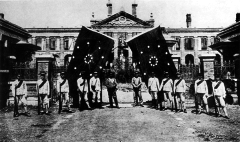
Accidental bomb detonation in a revolutionary safe house forced the conspirators' hand. On October 10, 1911, military units in Wuchang — part of the tri-city complex of Wuhan on the Yangtze River — mutinied against the Qing dynasty, triggering a chain reaction of provincial declarations of independence that toppled China's last imperial dynasty within four months. The Wuchang Uprising ended 2,132 years of imperial rule and gave birth to the Republic of China. The revolution had been building for decades. The Qing dynasty, founded by Manchu conquerors in 1644, had suffered a catastrophic century: defeat in the Opium Wars, the near-destruction of the Taiping Rebellion (which killed an estimated 20 million people), the humiliation of the Boxer Protocol, and a series of failed reform efforts that satisfied neither conservatives nor radicals. Sun Yat-sen, a Cantonese physician educated in Hawaii and Hong Kong, had been organizing revolutionary cells since the 1890s, attempting ten failed uprisings before Wuchang succeeded. The October 10 revolt was unplanned. Revolutionary cells within the Hubei New Army had been preparing an insurrection, but on October 9, a bomb accidentally exploded in a Wuchang safe house, alerting Qing authorities. Police seized membership lists and began arresting conspirators. Facing exposure and execution, the remaining revolutionaries decided to strike immediately rather than wait for better conditions. That evening, engineering troops of the 8th Division mutinied, seizing the ammunition depot and firing on their officers. By morning, the revolutionaries controlled Wuchang. They needed a figurehead with military prestige, so they dragged Brigade Commander Li Yuanhong from under his bed — literally, according to several accounts — and declared him military governor at gunpoint. The uprising might have been crushed if the Qing court had responded decisively. Instead, the dynasty hesitated, recalled the powerful general Yuan Shikai from retirement, and attempted to negotiate. Province after province declared independence from Beijing. By December, fourteen of China's eighteen provinces had seceded. Sun Yat-sen, who was in Denver, Colorado, during the uprising, returned to China and was inaugurated as provisional president on January 1, 1912. The last Qing emperor, six-year-old Puyi, abdicated on February 12, ending a dynastic tradition stretching back to 221 BCE.
October 10, 1911
115 years ago
Key Figures & Places



What Else Happened on October 10
Germanicus died vomiting in Antioch. He was 33, Rome's most popular general, and Tiberius's heir. His body showed signs of poisoning. His room contained curse t…
Germanicus succumbed to a mysterious, agonizing illness near Antioch, convinced that his rival, Governor Gnaeus Calpurnius Piso, had poisoned him. His death tri…

Seventy-two men faced an army of thousands on the plains of Karbala, and their deaths on October 10, 680 CE, created the deepest and most enduring schism in Isl…
Husayn ibn Ali fell in battle against the forces of the Umayyad Caliph Yazid I at Karbala, cementing the definitive schism between Sunni and Shia Islam. His dea…

Frankish infantry formed a massive square "like a wall of ice," as one Arab chronicler described it, and absorbed wave after wave of Muslim cavalry charges near…
Charles Martel’s Frankish infantry shattered the Umayyad Caliphate’s cavalry charge between Tours and Poitiers, halting the northern expansion of Islamic forces…
Talk to History
Have a conversation with historical figures who witnessed this era. Ask questions, explore perspectives, and bring history to life.