National Gallery Opens: Art Unites a Nation
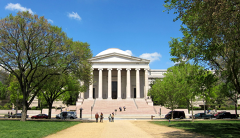
President Franklin Roosevelt officially opened the National Gallery of Art in Washington, D.C., on March 17, 1941, accepting a gift from financier Andrew Mellon that would become one of the world's premier art museums. Mellon had donated his personal collection of 121 paintings and 21 sculptures, along with $15 million to construct the building, and died in 1937 before seeing it completed. Mellon had been one of the wealthiest men in America, serving as Treasury Secretary under three presidents from 1921 to 1932. His art collection, assembled over decades with the help of the dealer Joseph Duveen, included masterworks by Raphael, Titian, Vermeer, Rembrandt, and Van Eyck. The most spectacular acquisition came in 1930-31, when Mellon secretly purchased 21 paintings from the Hermitage Museum in Leningrad, including works by Botticelli, Perugino, and Raphael, from the Soviet government, which was liquidating cultural assets to fund industrialization. Mellon's decision to donate his collection and fund a museum was shaped partly by his prosecution for tax evasion during the Roosevelt administration. Though he was eventually acquitted, the experience convinced him that a public gift of his art collection would protect his legacy. He deliberately insisted the museum not bear his name, believing that a gallery identified with a single collector would discourage other donors from contributing. The strategy worked brilliantly. The building, designed by John Russell Pope in a neoclassical style using Tennessee pink marble, was at the time the largest marble structure in the world. Its 780-foot facade along the National Mall established the gallery as a physical peer of the Capitol and the Lincoln Memorial. Within years of its opening, other major collectors followed Mellon's example. Samuel H. Kress, Chester Dale, Joseph Widener, and Lessing Rosenwald donated collections that expanded the gallery's holdings dramatically. The East Building, designed by I.M. Pei, opened in 1978 to house the growing modern art collection. Mellon's gallery proved that one man's vanity, properly channeled, could create an institution that enriches everyone.
March 17, 1941
85 years ago
Key Figures & Places
What Else Happened on March 17
Caesar's best general had turned against him, and at the Battle of Munda on March 17, 45 BC, that betrayal nearly succeeded. Titus Labienus, who had served as C…
Marcus Aurelius succumbed to illness in Vindobona, ending the era of the Five Good Emperors. His death elevated his son, Commodus, to sole power, abruptly halti…
He was Rome's first emperor born into the purple — literally raised in the palace — and Marcus Aurelius knew it was a mistake. The philosopher-emperor spent his…
He murdered the emperor, then forced the widow to marry him — all within days. Petronius Maximus bribed enough senators to claim the Western Roman throne in Mar…
Petronius Maximus seized the Western Roman throne with the Senate’s backing just one day after orchestrating the assassination of Valentinian III. His reign las…
Patrick died at Saul, County Down, around March 17, 461, after spending nearly thirty years converting the Irish to Christianity. He arrived on an island of dru…
Talk to History
Have a conversation with historical figures who witnessed this era. Ask questions, explore perspectives, and bring history to life.