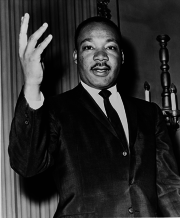
King Wins Nobel at 35: Civil Rights Leader Honored
Martin Luther King Jr. was just 35 years old when the Norwegian Nobel Committee announced on October 14, 1964, that he had won the Nobel Peace Prize, making him the youngest recipient at that time. The award recognized his leadership of the nonviolent civil rights movement that had transformed American society through sit-ins, marches, boycotts, and moral persuasion rather than armed resistance. King had emerged as the leading voice of the civil rights movement during the Montgomery Bus Boycott of 1955-56, when a young Baptist minister organized a thirteen-month campaign that desegregated public buses in Alabama's capital. His philosophy of nonviolent resistance, drawn from Mahatma Gandhi and the Christian social gospel tradition, offered a strategic and moral framework that proved devastatingly effective against the brutality of Southern segregation. Television cameras broadcasting images of peaceful marchers attacked by police dogs and fire hoses in Birmingham in 1963 turned national opinion decisively against Jim Crow. By the time of the Nobel announcement, King had already delivered the "I Have a Dream" speech to 250,000 people at the March on Washington and had been instrumental in the passage of the Civil Rights Act of 1964, which outlawed discrimination based on race, color, religion, sex, or national origin. The Nobel Prize validated the movement on the world stage and gave King international moral authority. King donated the $54,123 prize money to the civil rights movement. He accepted the award in Oslo on December 10, declaring that "nonviolence is the answer to the crucial political and moral question of our time." The honor strengthened his position as he turned his attention to voting rights — the Selma-to-Montgomery marches and the Voting Rights Act of 1965 followed within months. King continued to expand his activism to address poverty and the Vietnam War before his assassination in Memphis on April 4, 1968, at age 39. The Nobel Prize stands as recognition that the American civil rights movement was not merely a domestic matter but a contribution to the moral progress of humanity.
October 14, 1964
62 years ago
Key Figures & Places
What Else Happened on October 14
Pope Callixtus I was thrown down a well by a mob in Trastevere. He'd been pope for five years and had enemies — he'd allowed Christians who'd committed adultery…
William the Conqueror's army met King Harold's forces at Hastings on October 14th, 1066. Harold had just marched 250 miles from defeating Vikings in the north. …
An arrow struck King Harold II in the eye — or so the Bayeux Tapestry appears to show — and with his death on a Sussex hillside on October 14, 1066, an entire c…
Robert the Bruce routed Edward II's English army at Byland Abbey in Yorkshire on October 14, 1322, chasing the English king into a panicked flight that left his…
Radu cel Frumos — Radu the Handsome — issued a writ from Bucharest in 1465. It's the first official document mentioning Bucharest as a residence of a Wallachian…
October 5th was Thursday. October 15th was Friday. The ten days between didn't happen. Pope Gregory XIII's calendar reform deleted them to realign Easter with t…
Talk to History
Have a conversation with historical figures who witnessed this era. Ask questions, explore perspectives, and bring history to life.