Yeager Breaks Sound Barrier: Supersonic Flight
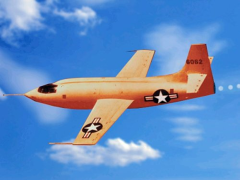
Chuck Yeager climbed into the bright orange Bell X-1 with two cracked ribs, a secret he'd kept from his commanding officers because he refused to be grounded. On October 14, 1947, the 24-year-old test pilot from Hamlin, West Virginia, dropped from the bomb bay of a B-29 at 25,000 feet and fired the X-1's four rocket chambers, accelerating past Mach 1 over the Mojave Desert. A sonic boom rolled across the dry lakebed at Muroc Army Air Field — the first ever produced by a piloted aircraft in level flight. The quest to break the sound barrier had been treated with near-superstitious dread by the aviation community. Several pilots had died when their aircraft became uncontrollable near transonic speeds, as shock waves disrupted airflow over conventional wing designs. Some engineers genuinely believed that a solid "barrier" existed at the speed of sound that no aircraft could survive. The British had abandoned their own supersonic program after test pilot Geoffrey de Havilland Jr. died when his experimental aircraft disintegrated in September 1946. Yeager named his aircraft "Glamorous Glennis" after his wife. The X-1's design, based on a .50-caliber bullet shape known to be stable at supersonic speeds, used a thin straight wing and a rocket engine burning ethyl alcohol and liquid oxygen. The flight plan called for a gradual approach to Mach 1 over several test flights, but Yeager pushed through the barrier ahead of schedule. His instruments registered Mach 1.06 at 43,000 feet. The U.S. Air Force classified the achievement for nearly a year, and the first public reports were met with skepticism. When the news finally broke, Yeager became an international celebrity and the embodiment of the test pilot mystique. His flight opened the supersonic age and proved that the "barrier" was an engineering challenge, not a physical wall. Within a decade, military jets routinely exceeded Mach 1, and the principles proven by the X-1 program fed directly into the design of spacecraft that would carry astronauts beyond the atmosphere entirely.
October 14, 1947
79 years ago
Key Figures & Places
What Else Happened on October 14
Pope Callixtus I was thrown down a well by a mob in Trastevere. He'd been pope for five years and had enemies — he'd allowed Christians who'd committed adultery…
William the Conqueror's army met King Harold's forces at Hastings on October 14th, 1066. Harold had just marched 250 miles from defeating Vikings in the north. …
An arrow struck King Harold II in the eye — or so the Bayeux Tapestry appears to show — and with his death on a Sussex hillside on October 14, 1066, an entire c…
Robert the Bruce routed Edward II's English army at Byland Abbey in Yorkshire on October 14, 1322, chasing the English king into a panicked flight that left his…
Radu cel Frumos — Radu the Handsome — issued a writ from Bucharest in 1465. It's the first official document mentioning Bucharest as a residence of a Wallachian…
October 5th was Thursday. October 15th was Friday. The ten days between didn't happen. Pope Gregory XIII's calendar reform deleted them to realign Easter with t…
Talk to History
Have a conversation with historical figures who witnessed this era. Ask questions, explore perspectives, and bring history to life.