Diana's Funeral: Two Billion Mourn Together
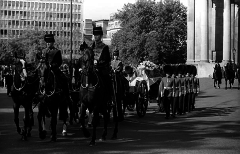
The funeral cortege of Diana, Princess of Wales, left Kensington Palace at 9:08 a.m. on September 6, 1997, carried on a gun carriage through streets lined by over a million mourners who stood in near-total silence as the coffin passed. An estimated 2.5 billion people watched the ceremony worldwide, making it one of the most viewed events in the history of television. Three white wreaths lay atop the coffin draped in the royal standard: one from her brother, one from Prince William, and one from 12-year-old Prince Harry, who had placed a card among the flowers that read simply "Mummy." Diana had died six days earlier in a car crash in the Pont de l'Alma tunnel in Paris, along with her companion Dodi Fayed and driver Henri Paul, who was later found to have been driving at high speed with a blood alcohol level more than three times the French legal limit. The paparazzi who had been pursuing her car were initially suspected of causing the crash, and public fury toward the tabloid press was immediate and fierce. The outpouring of grief that followed was unlike anything Britain had experienced in living memory, with mourners leaving an ocean of flowers outside Kensington Palace that stretched for blocks. The royal family's initial response was widely perceived as cold and out of touch. Queen Elizabeth II remained at Balmoral for days after the death, and no flag flew at half-staff over Buckingham Palace, a decision defended by protocol but condemned by the public. The queen ultimately bowed to public pressure, returning to London, ordering the Union Flag lowered to half-mast, and delivering a televised tribute to Diana on the eve of the funeral. The ceremony at Westminster Abbey featured an address by Diana's brother, Earl Spencer, whose barely contained anger at both the press and the royal family drew sustained applause that rippled from the crowds outside into the abbey itself. Elton John performed a reworked version of "Candle in the Wind," originally written about Marilyn Monroe, that became the best-selling single in history. Diana's death and funeral exposed the widening gap between the British monarchy's traditions and the emotional expectations of a modern public.
September 6, 1997
29 years ago
Key Figures & Places
What Else Happened on September 6
The Maya Long Count calendar began its current cycle on this day, anchoring a sophisticated system of timekeeping that tracked thousands of years with mathemati…
The Battle of the Frigidus wasn't just Theodosius I defeating a usurper — it was the last time a Roman army fought under pagan standards against a Christian emp…
Columbus had already been to La Gomera once before and turned back. This time he left the Canary Islands on September 6, 1492, with three ships and roughly 90 m…
The Victoria, a battered carrack with only 18 surviving crew members aboard, limped into the harbor at Sanlucar de Barrameda, Spain, on September 6, 1522, compl…
The Mayflower weighed anchor and departed Plymouth, England, on September 6, 1620, carrying 102 passengers and approximately 30 crew members on a 66-day voyage …
A September hurricane drove the Spanish galleon Nuestra Señora de Atocha to the ocean floor near Key West in 1622, drowning 260 of its 265 passengers and crew. …
Talk to History
Have a conversation with historical figures who witnessed this era. Ask questions, explore perspectives, and bring history to life.