
Pilgrims Sail on the Mayflower: New World Beckons
The Mayflower weighed anchor and departed Plymouth, England, on September 6, 1620, carrying 102 passengers and approximately 30 crew members on a 66-day voyage across the North Atlantic toward a new life in North America. Roughly half the passengers were Separatist Puritans from Leiden, Netherlands, who had left England to worship freely but found Dutch society too liberal for their strict religious vision. The rest were what the Separatists called "Strangers," a mix of servants, craftsmen, and adventurers recruited to make the colony commercially viable for the merchant investors who had financed the expedition. The Mayflower was not the original choice for the voyage. A smaller ship, the Speedwell, was supposed to accompany it, but the Speedwell proved so leaky that the fleet turned back twice before the passengers consolidated onto the Mayflower alone. The delays pushed the departure dangerously late in the sailing season, meaning the colonists would arrive in North America at the onset of winter rather than with months to prepare shelters and plant crops. This timing decision contributed directly to the catastrophic mortality of the first winter. The crossing itself was brutal. The Mayflower, a cargo vessel roughly 100 feet long, packed its passengers below deck in a space about 80 feet by 25 feet with a ceiling height of barely five feet. Storms battered the ship so severely that a main beam cracked and had to be reinforced with a large iron screw the passengers had brought for their printing press. One passenger died during the voyage, and one child was born, whom his parents named Oceanus. The Mayflower made landfall at Cape Cod on November 11, 1620, far north of the intended destination in Virginia. Before going ashore, 41 of the male passengers signed the Mayflower Compact, a brief agreement to form a self-governing body and abide by majority rule. This document, drafted to prevent conflict between the Saints and the Strangers, became a foundational text in the development of American democratic self-governance. Half the passengers died during the first winter from disease, exposure, and malnutrition, but the colony at Plymouth survived and became the symbolic origin of English America.
September 6, 1620
406 years ago
Key Figures & Places
England
Wikipedia
Old Style
Wikipedia
North America
Wikipedia
Pilgrims
Wikipedia
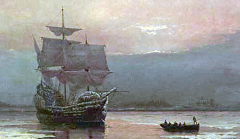
Mayflower
Wikipedia
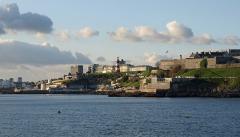
Plymouth
Wikipedia
September 16
Wikipedia
New Style
Wikipedia
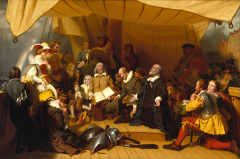
Pilgrims
Wikipedia
Pilgrims (Plymouth Colony)
Wikipedia
Plymouth
Wikipedia
Mayflower
Wikipedia
Old Style and New Style dates
Wikipedia
September 16
Wikipedia
North America
Wikipedia
What Else Happened on September 6
The Maya Long Count calendar began its current cycle on this day, anchoring a sophisticated system of timekeeping that tracked thousands of years with mathemati…
The Battle of the Frigidus wasn't just Theodosius I defeating a usurper — it was the last time a Roman army fought under pagan standards against a Christian emp…
Columbus had already been to La Gomera once before and turned back. This time he left the Canary Islands on September 6, 1492, with three ships and roughly 90 m…
The Victoria, a battered carrack with only 18 surviving crew members aboard, limped into the harbor at Sanlucar de Barrameda, Spain, on September 6, 1522, compl…
A September hurricane drove the Spanish galleon Nuestra Señora de Atocha to the ocean floor near Key West in 1622, drowning 260 of its 265 passengers and crew. …
John Endecott and his group of settlers established a permanent foothold at Naumkeag, soon renamed Salem. This outpost provided the logistical anchor for the Gr…
Talk to History
Have a conversation with historical figures who witnessed this era. Ask questions, explore perspectives, and bring history to life.