

Dybbøl Falls: Prussia Strips Denmark of Schleswig
Prussian infantry stormed the Danish fortifications at Dybbol on April 18, 1864, after a two-week bombardment that had reduced the redoubts to rubble and buried defenders under tons of earth. The assault lasted thirty minutes. Roughly 37,000 Prussian troops overwhelmed a Danish garrison of 11,000, killing 671 Danes and capturing 3,534. The battle decided the Second Schleswig War and stripped Denmark of the duchies of Schleswig, Holstein, and Lauenburg, territories that contained nearly forty percent of the Danish kingdom's population. The Schleswig-Holstein question had bedeviled European diplomacy for decades. The duchies were ruled by the Danish crown but contained large German-speaking populations, and their constitutional status was tangled in a knot of feudal inheritance law that Lord Palmerston reportedly said only three people had ever understood: one was dead, one had gone mad, and the third had forgotten. When Denmark tried to integrate Schleswig directly into the Danish state in 1863, Prussia and Austria found the pretext they needed for war. Otto von Bismarck, the Prussian Minister-President, orchestrated the conflict with calculated precision. He secured Austrian participation to provide diplomatic cover, then used the joint victory to create the conditions for a Prussian-Austrian war two years later. The defeat at Dybbol was a national trauma for Denmark. The country lost a third of its territory and entered a period of cultural introversion, redirecting national energy from external ambitions to internal development under the philosophy "what is lost without must be gained within." For Bismarck, Dybbol was the first step in a sequence of three wars that unified Germany under Prussian leadership. Austria was defeated in 1866, France in 1870-71, and the German Empire was proclaimed at Versailles. Denmark's loss fed into the forces that reshaped the European map entirely. Schleswig was partitioned after a 1920 plebiscite following Germany's defeat in World War I, with northern Schleswig returning to Denmark, but the southern portion remains German territory. Dybbol itself has become Denmark's most sacred battlefield, commemorated annually on April 18.
April 18, 1864
162 years ago
Key Figures & Places
Denmark
Wikipedia
Kingdom of Prussia
Wikipedia

Austrian Empire
Wikipedia
Duchy of Schleswig
Wikipedia
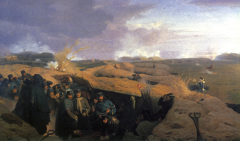
Battle of Dybbøl
Wikipedia

Battle of Dybbøl
Wikipedia

Kingdom of Prussia
Wikipedia

Austrian Empire
Wikipedia

Duchy of Schleswig
Wikipedia

Frédéric-Charles de Prusse
Wikipedia
Second Schleswig War
Wikipedia
Prussia
Wikipedia

Histoire du Danemark
Wikipedia
What Else Happened on April 18
Corbridge blood ran red before dawn in 796. King Æthelred I didn't die in battle; he was hacked down by his own ealdormen, Ealdred and Wada. The human cost? Pur…

Boleslaw Chrobry was crowned the first king of Poland at Gniezno Cathedral on April 18, 1025, unifying the Slavic tribes between the Oder and Bug rivers into a …
They signed ink over spilled wine in Ferrara while Venice's doge demanded Mantua's taxes. Milan's soldiers, exhausted and unpaid, finally sheathed their swords …

Pope Julius II laid the cornerstone of the new St. Peter's Basilica on April 18, 1506, beginning a construction project that would take 120 years, consume the f…
A Milanese princess walked into Kraków's cathedral clutching a trunk of oranges, saffron, and eggplants. She didn't just marry a king; she imported an entire Re…
A heavy cloak, worn for weeks on the road, barely hid Luther's trembling hands as he faced the Emperor. He stood in a room where silence could kill him, yet he …
Talk to History
Have a conversation with historical figures who witnessed this era. Ask questions, explore perspectives, and bring history to life.