

Historical Figure
Werner Heisenberg
1901–1976
German theoretical physicist (1901–1976)
What do you want Werner Heisenberg to say?
Sign up free to hear it.
Talk to Werner Heisenberg
Have a conversation with this historical figure through AI
Biography
Werner Karl Heisenberg was a German theoretical physicist, one of the main pioneers of the theory of quantum mechanics and a principal scientist in the German nuclear program during World War II.
Timeline
The story of Werner Heisenberg, told in moments.
Publishes his Umdeutung paper. He's recovering from hay fever on the island of Helgoland when the math clicks. With Max Born and Pascual Jordan, he develops matrix mechanics. It's the first rigorous formulation of quantum theory. He is 23.
Publishes the uncertainty principle. You can know a particle's position or its momentum. Not both. Not because of bad instruments. Because that's how reality works at the quantum scale. The paper is three pages. It upends three centuries of physics.
Wins the Nobel Prize in Physics at 31 "for the creation of quantum mechanics." He's the youngest theoretical physicist to win it. His mother writes to Bohr's mother to ask whether Niels is upset that Werner won alone. She never gets a clear answer.
Leads Germany's nuclear energy project during the war. Whether he intentionally slowed the development of an atomic bomb or simply failed to build one is one of the most debated questions in the history of science. He visits Bohr in occupied Copenhagen. Neither man ever agrees on what was said.
Dies of kidney and gallbladder cancer in Munich at 74. He spent his postwar career directing the Max Planck Institute for Physics. His name now means two things: a pillar of quantum mechanics, and a question about what scientists owe the world when the world is at war.
In Their Own Words (20)
After these conversations with Tagore some of the ideas that had seemed so crazy suddenly made much more sense. That was a great help for me.
On conversations with Rabindranath Tagore, as quoted in Uncommon Wisdom: Conversations With Remarkable People (1988) by Fritjof Capra, who states that after these "He began to see that the recognition of relativity, interconnectedness, and impermanence as fundamental aspects of physical reality, which had been so difficult for himself and his fellow physicists, was the very basis of the Indian spiritual traditions.", 1988
There is a fundamental error in separating the parts from the whole, the mistake of atomizing what should not be atomized. Unity and complementarity constitute reality.
Heisenberg's praise for Ruth Anshen's book Biography of An Idea found on the back cover—the book was published in 1986 after his death, but was the result of conversations over many years, including some with Heisenberg discussed starting on p. 39., 1986
In general, scientific progress calls for no more than the absorption and elaboration of new ideas — and this is a call most scientists are happy to heed.
Physics and Beyond : Encounters and Conversation (1971), p. 70, 1971
Can you, or anyone else, reach the central order of things or events, whose existence seems beyond doubt, as directly as you can reach the soul of another human being? I am using the term 'soul' quite deliberately so as not to be misunderstood. If you put your question like that, I would say yes. ... the word 'soul' refers to the central order, to the inner core of a being whose outer manifestations may be highly diverse and pass our understanding.
In response to the question "Do you believe in a personal God?" from Wolfgang Pauli, as recalled in Physics and Beyond : Encounters and Conversation (1971), p. 215, 1971
If nature leads us to mathematical forms of great simplicity and beauty—by forms I am referring to coherent systems of hypothesis, axioms, etc.—to forms that no one has previously encountered, we cannot help thinking that they are "true," that they reveal a genuine feature of nature. It may be that these forms also cover our subjective relationship to nature, that they reflect elements of our own thought economy. But the mere fact that we could never have arrived at these forms by ourselves, that they were revealed to us by nature, suggests strongly that they must be part of reality itself, not just of our thoughts about reality. ... You must have felt this too: The almost frightening simplicity and wholeness of relationships which nature suddenly spreads out before us and for which none of us was in the least prepared.
Conversation with Einstein, recalled English translation of his book Physics and Beyond (1971), pp. 68-69., 1971
Artifacts (15)
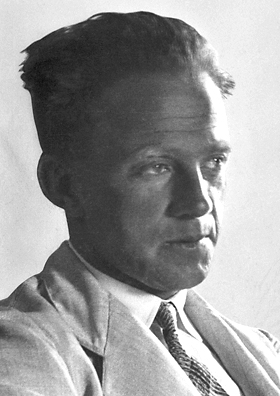
Werner Heisenberg cropped
o.Ang., possibly licensed to Nobel Foundation or Deutsches Bundesarchiv (German Federal Archive), Bild 183-1986-0310-501


More from the Late 20th Century


Explore what happened on the days that shaped Werner Heisenberg's life. Today In History connects historical figures with the events, births, and deaths that defined their era. Browse all historical figures or explore today's events.