

Historical Figure
Herbert Hoover
1874–1964
President of the United States from 1929 to 1933
What do you want Herbert Hoover to say?
Sign up free to hear it.
Hear the original recording — “Presidential Campaign Address” (August 11, 1932) →
Talk to Herbert Hoover
Have a conversation with this historical figure through AI
Biography
Herbert Clark Hoover was the 31st president of the United States, serving from 1929 to 1933. A wealthy mining engineer before his presidency, Hoover led the wartime Commission for Relief in Belgium and was the director of the U.S. Food Administration, followed by post-war relief of Europe. As a member of the Republican Party, he served as the third United States secretary of commerce from 1921 to 1928 before being elected president in 1928. His presidency was dominated by the Great Depression, and his policies and methods to combat it were seen as inadequate and overly conservative. Amid his unpopularity, he decisively lost reelection to Franklin D. Roosevelt in 1932.
Timeline
The story of Herbert Hoover, told in moments.
Organized food relief for 10 million Belgians trapped behind German lines during WWI. He was a private citizen. No government authority. He just did it. They called him "the Great Humanitarian."
Organizes the evacuation of 120,000 Americans stranded in Europe at the start of World War I. Then feeds Belgium. His Commission for Relief runs a $12 million monthly operation feeding 9 million civilians through the German blockade. He's 40 and has never held office.
Appears on the first long-distance television transmission. His face is transmitted from Washington to New York over 200 miles of wire. The image is blurry and one inch tall.
Elected president in a landslide. He'd never held elected office before. He promised "a chicken in every pot and a car in every garage." The stock market crashed eleven months later.
Stands before Congress and declares the economy sound. The crash happened two months ago. He believes in voluntary cooperation between government and business. He's wrong. Within a year, 4 million Americans will be unemployed.
Ordered the Army to clear the Bonus March veterans' camp from Washington. Troops used tear gas and bayonets on WWI veterans and their families. Douglas MacArthur led the assault. The images destroyed Hoover politically.
Orders the Army to clear the Bonus Army from Washington. General MacArthur leads infantry, cavalry, and six tanks against 43,000 unarmed veterans and their families camped along the Anacostia River. The images destroy what's left of Hoover's presidency.
Dies in New York at 90. He'd lived 31 years after leaving the White House. Truman asked him to lead famine relief after World War II. He fed Europe again. He outlived every insult the Depression years threw at him.
In Their Own Words (20)
I am firmly opposed to the government entering into any business the major purpose of which is competition with our citizens... for the Federal Government deliberately to go out to build up and expand... a power and manufacturing business is to break down the initiative and enterprise of the American people; it is the destruction of equality of opportunity amongst our people, it is the negation of the ideals upon which our civilization has been based.
On vetoing the "Muscle Shoals Bill" which was the seed for the later creation of the Tennessee Valley Authority, 1971
Every collectivist revolution rides in on a Trojan horse of 'emergency'. It was the tactic of Lenin, Hitler, and Mussolini. In the collectivist sweep over a dozen minor countries of Europe, it was the cry of men striving to get on horseback. And 'emergency' became the justification of the subsequent steps. This technique of creating emergency is the greatest achievement that demagoguery attains... The invasion of New Deal Collectivism was introduced by this same Trojan horse.
p. 357, 1952
In the large sense the primary cause of the Great Depression was the war of 1914-1918. Without the war there would have been no depression of such dimensions. There might have been a normal cyclical recession; but, with the usual timing, even that readjustment probably would not have taken place at that particular period, nor would it have been a "Great Depression."
p. 2: Lead paragraph Chapter 1 : The origins of the Depression., 1952
The recognition of Russia on November 16, 1933, started forces which were to have considerable influence in the attempt to collectivize the United States.
p. 484, 1952
When we are sick, we want an uncommon doctor; when we have a construction job to do, we want an uncommon engineer, and when we are at war, we want an uncommon general. It is only when we get into politics that we are satisfied with the common man.
From an article originally published in the February 6, 1949 issue of "This Week" Magazine, from "Addresses Upon the American Road,Volume: Volume 8: 1955-1960." Developed in speech entitled "Moral and Spiritual Recovery from War" presented October 13, 1945, at 75th Anniversary of Wilson College at Chambersburg, Pennsylvania. "The Crusade Years, 1933–1955: Herbert Hoover's Lost Memoir of the New Deal Era and Its Aftermath", edited by George Nash, 1949
Artifacts (15)
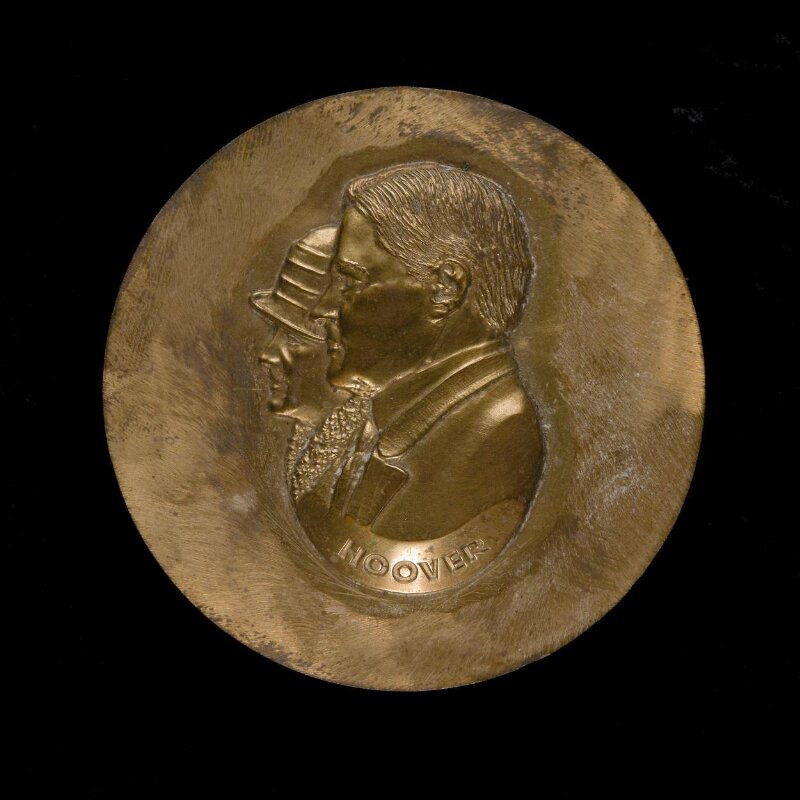


More from the Industrial


Explore what happened on the days that shaped Herbert Hoover's life. Today In History connects historical figures with the events, births, and deaths that defined their era. Browse all historical figures or explore today's events.