

Historical Figure
Enrico Fermi
1901–1954
Italian-American physicist (1901–1954)
What do you want Enrico Fermi to say?
Sign up free to hear it.
Talk to Enrico Fermi
Have a conversation with this historical figure through AI
Biography
Enrico Fermi was an Italian–American physicist, renowned for being the creator of the world's first artificial nuclear reactor, the Chicago Pile-1, and a member of the Manhattan Project. He won the 1938 Nobel Prize in Physics "for his demonstrations of the existence of new radioactive elements produced by neutron irradiation, and for his related discovery of nuclear reactions brought about by slow neutrons". He has been called the "architect of the nuclear age" and the "architect of the atomic bomb". He was one of very few physicists to excel in both theoretical and experimental physics. With his colleagues, Fermi filed several patents related to the use of nuclear power, all of which were taken over by the US government. He made significant contributions to the development of statistical mechanics, quantum theory, and nuclear and particle physics.
Timeline
The story of Enrico Fermi, told in moments.
Receives his degree at age 20 from the Scuola Normale Superiore in Pisa. His examiner, after reading his entrance essay on vibrating rods using Fourier analysis, had declared the 17-year-old "would become an outstanding physicist." The director of the physics lab admitted there was little he could teach Fermi and asked Fermi to teach him instead.
Switches from theory to experiment. Bombards elements with neutrons and discovers that slow neutrons are captured more easily than fast ones. He thinks he's created new elements. He wins the Nobel Prize for it in 1938. The "new elements" turn out to be fission products. He doesn't know it yet, but he's stumbled onto how to split the atom.
Travels to Stockholm to collect his Nobel Prize, then keeps going. He never returns to Italy. Mussolini's new racial laws threaten his Jewish wife Laura. The Nobel money pays for the family's passage to America.
Chicago. A squash court under the stands of Stagg Field. Fermi's team brings Chicago Pile-1 to criticality at 3:25 p.m. The first self-sustaining nuclear chain reaction in history. Arthur Compton calls James Conant: "The Italian navigator has just landed in the new world."
Trinity test, Alamogordo, New Mexico. Fermi tears up small pieces of paper and drops them before and after the shockwave hits. From how far they scatter, he estimates the yield at 10 kilotons. The actual answer: 21 kilotons. He's off by a factor of two, using paper scraps in the desert. They call it the Fermi method.
Dies of stomach cancer in Chicago at 53. An element, a lab, a space telescope, a reactor, and a paradox all carry his name. One of 16 scientists with an element named after them.
In Their Own Words (7)
There are two possible outcomes: if the result confirms the hypothesis, then you've made a measurement. If the result is contrary to the hypothesis, then you've made a discovery.
As quoted in Nuclear Principles in Engineering (2005) by Tatjana Jevremovic, p. 397, 2005
If I could remember the names of all these particles, I'd be a botanist.
As quoted in Hyperspace (1995) by Michio Kaku, 1995
I cannot think of a single one, not even intelligence.
When asked what characteristics Nobel prize winning physicists had in common. As quoted in Physics Today (October 1994), p. 70., 1994
I hope it won't take long.
Comment to Eugene Wigner, ten days before his death from cancer, as quoted in The collected works of Eugene Paul Wigner (1992), p. 108, 1992
Where are they?
Variant: Where is everybody? : The Fermi paradox spoken in 1950 regarding the lack of evidence of extra-terrestrial intelligence. As quoted in "Where are They? Maybe we are alone in the galaxy after all" by Ian Crawford in Scientific American (July 2000), p. 38-43 (PDF document); also in "Our Galaxy Should Be Teeming With Civilizations, But Where Are They?" by Seth Shostak at Space.com (25 October 2001), 1950
Artifacts (15)
![ENRICO FERMI [Material gráfico]](https://www.fotosantiguascanarias.org/oaistore/srvimg/img102/00014001_00014500/00014288/alta/00014288_0001.jpg)
La raccolta Fiano (IA laraccoltafiano00soma)
Somaré, Enrico, 1889- Spadini, Armando, 1883-1925 Galleria Pesaro (Milan, Italy)
Ottorino Respighi ed Enrico Fermi in viaggio per il Sud America. Ritratto doppio
Anonymous
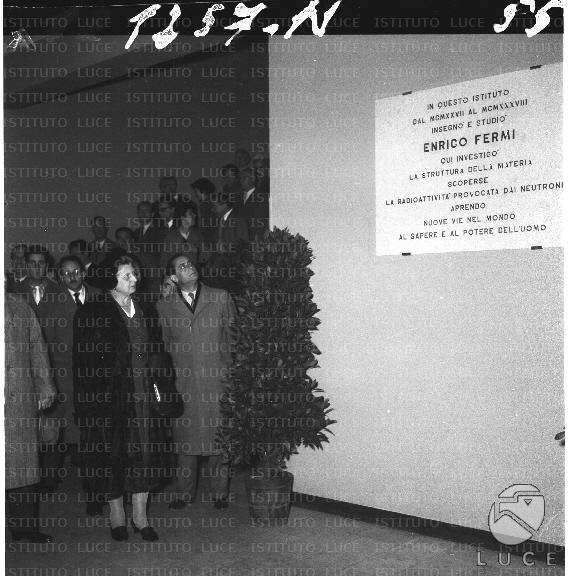
Participants of the commemoration look at the plaque dedicated to Enrico Fermi in the University of Rome -
Notizie generali dei celebri affreschi esistenti nella libreria della Metropolitana di Siena (IA notiziegeneralid00sien)
More from the Modern


Explore what happened on the days that shaped Enrico Fermi's life. Today In History connects historical figures with the events, births, and deaths that defined their era. Browse all historical figures or explore today's events.