

Historical Figure
Andrew Johnson
1808–1875
President of the United States from 1865 to 1869
Talk to Andrew Johnson
Have a conversation with this historical figure through AI
Biography
Andrew Johnson was the 17th president of the United States, serving from 1865 to 1869. The 16th vice president, he assumed the presidency following the assassination of Abraham Lincoln. Johnson was a War Democrat who ran with Lincoln on the National Union Party ticket in the 1864 presidential election, coming to office as the American Civil War concluded. Johnson favored quick restoration of the seceded states to the Union without protection for the newly freed people who were formerly enslaved, as well as pardoning ex-Confederates. This led to conflict with the Republican Party-dominated U.S. Congress, culminating in his impeachment by the House of Representatives in 1868. He was acquitted in the Senate by one vote.
Timeline
The story of Andrew Johnson, told in moments.
Sworn in as the 17th president at a Washington boarding house, hours after Lincoln's death. A conspirator had been assigned to kill Johnson too but lost his nerve.
Impeached by the House of Representatives. The Senate acquitted him by a single vote. Seven Republicans broke ranks. Kansas Senator Edmund Ross, who cast the deciding vote, said: "I almost literally looked down into my open grave."
Died of a stroke at 66. He'd been elected to the Senate just months before, the only former president to serve in the Senate after leaving office.
In Their Own Words (20)
Mr. Jefferson meant the white race.
Regarding the statement in the Declaration of Independence that "all men are created equal.", 1972
Your President is now the Tribune of the people, and, thank God, I am, and intend to assert the power which the people have placed in me... Tyranny and despotism can be exercised by many, more rigorously, more vigorously, and more severely, than by one.
As quoted in Presidential Government in the United States: The Unwritten Constitution (1947) by Caleb Perry Patterson., 1947
The goal to strive for is a poor government but a rich people.
As quoted in Andrew Johnson, Plebeian and Patriot (1928) by Robert Watson Winston, 1928
Legislation can neither be wise nor just which seeks the welfare of a single interest at the expense and to the injury of many and varied interests at least equally important and equally deserving the considerations of Congress.
Veto message to the House of Representatives (22 February 1869)., 1869
It may be safely assumed as an axiom in the government of states that the greatest wrongs inflicted upon a people are caused by unjust and arbitrary legislation, or by the unrelenting decrees of despotic rulers, and that the timely revocation of injurious and oppressive measures is the greatest good that can be conferred upon a nation. The legislator or ruler who has the wisdom and magnanimity to retrace his steps when convinced of error will sooner or later be rewarded with the respect and gratitude of an intelligent and patriotic people. Our own history, although embracing a period less than a century, affords abundant proof that most, if not all, of our domestic troubles are directly traceable to violations of the organic law and excessive legislation.
1868
Artifacts (15)

Andrew Johnson by William Brown Cooper
Attributed to William Brown Cooper (1811-1900)


Mrs. Andrew Bedford Bankson and Son, Gunning Bedford Bankson by Joshua Johnson
Joshua Johnson

Andrew Johnson
Ehrgott & Forbriger Lithography Company, active 1856 - 1869

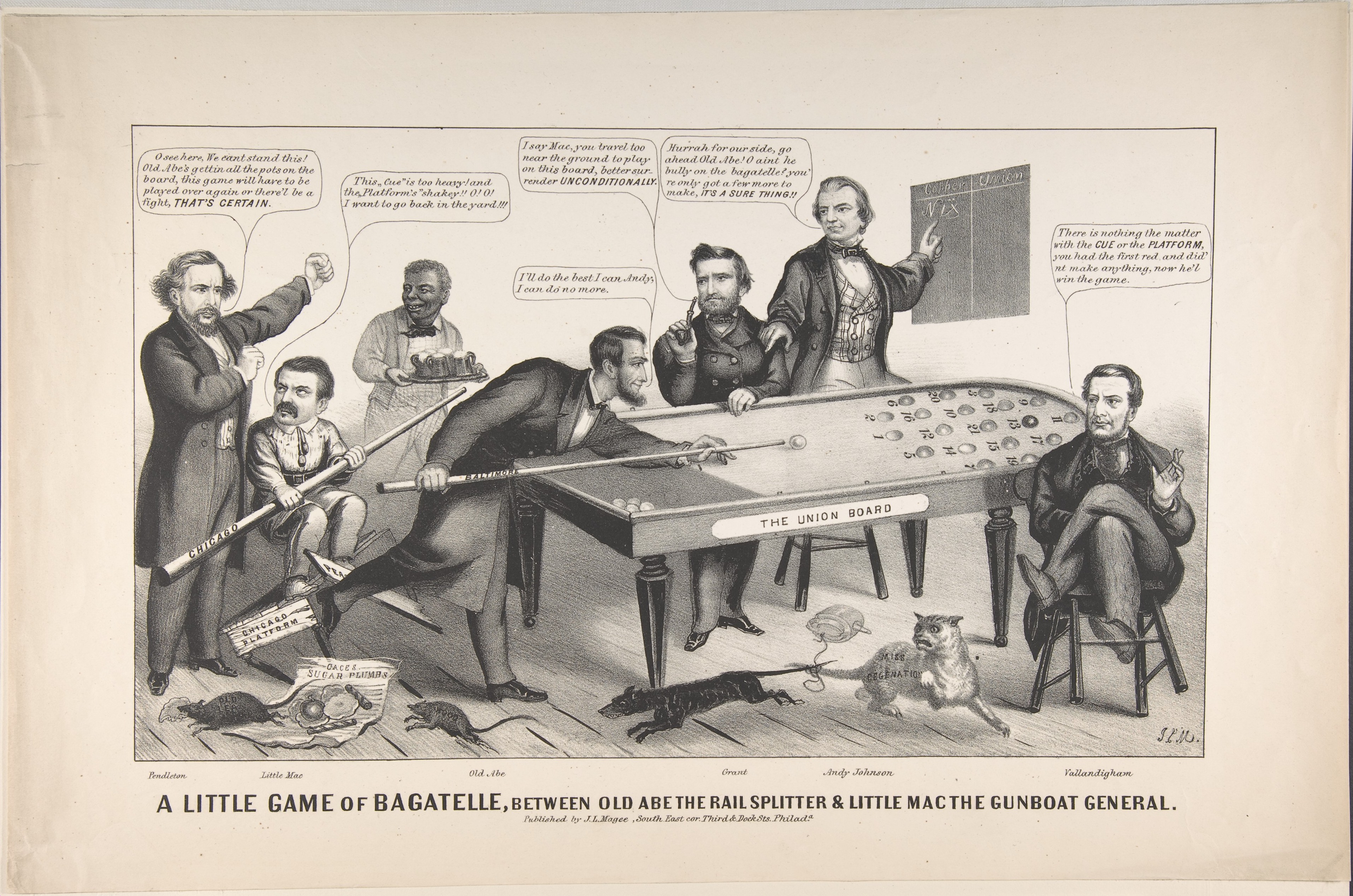
A Little Game of Bagatelle, Between Old Abe the Rail Splitter & Little Mac the Gunboat General
John L. Magee|Ulysses S. Grant|General George B. McClellan|Abraham Lincoln|Andrew Johnson

-Presidential Campaign Medal with Portraits of Abraham Lincoln and Andrew Johnson- MET DP269377
Unknown authorUnknown author
More from the Unknown



Explore what happened on the days that shaped Andrew Johnson's life. Today In History connects historical figures with the events, births, and deaths that defined their era. Browse all historical figures or explore today's events.