

Somme Ends: One Million Casualties for Seven Miles
British commander Douglas Haig finally called off the Battle of the Somme after 141 days of fighting that had advanced the front line approximately seven miles at a cost of more than one million casualties on both sides. The battle, which had opened with the bloodiest single day in British military history, became the defining catastrophe of World War I and a permanent symbol of the futility of industrial warfare directed by commanders who seemed unable to learn from their own failures. The offensive began on July 1, 1916, after a week-long artillery bombardment that fired 1.75 million shells at the German positions. The barrage was supposed to destroy the deep German dugouts and cut the barbed wire. It did neither. When British infantry went over the top at 7:30 a.m., advancing in rigid lines at walking pace across no man's land, they met intact machine gun positions. The first day produced 57,470 British casualties, including 19,240 dead, most falling in the first hour. Haig continued the offensive for four and a half more months. The tactical approach evolved, with creeping barrages, night attacks, and small-unit infiltration replacing the massed charges of July. The British debut of tanks at Flers-Courcelette on September 15 demonstrated a potential breakthrough weapon, though the early Mark I tanks were too slow, too unreliable, and too few to be decisive. The Germans suffered nearly as heavily as the attackers. Falkenhayn's policy of immediate counterattack to recapture any lost ground meant German soldiers were fed into the same meat grinder. Total German casualties are estimated at 450,000 to 600,000. The battle consumed divisions on both sides at a rate that neither army could indefinitely sustain.
November 18, 1916
110 years ago
Key Figures & Places

France
Wikipedia
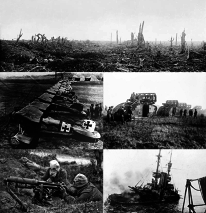
World War I
Wikipedia
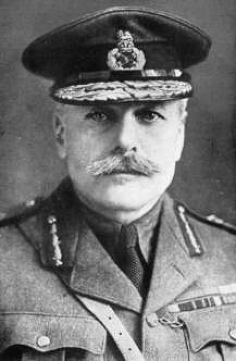
Douglas Haig, 1st Earl Haig
Wikipedia
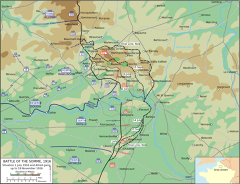
Battle of the Somme (1916)
Wikipedia
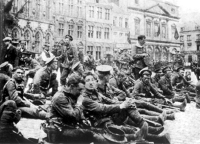
British Expeditionary Force (World War I)
Wikipedia

World War I
Wikipedia

Battle of the Somme
Wikipedia
British Expeditionary Force (World War I)
Wikipedia

Douglas Haig, 1st Earl Haig
Wikipedia

Paul von Hindenburg
Wikipedia

Weimarer Nationalversammlung
Wikipedia

Dolchstoßlegende
Wikipedia

First Battle of Ypres
Wikipedia
Força Expedicionária Britânica
Wikipedia
What Else Happened on November 18
Elisha P. Ferry was inaugurated as the first governor of Washington State, just days after it was admitted to the Union as the 42nd state. Ferry, a Republican w…
Emperor Constantine's massive basilica over St. Peter's burial site was consecrated after nearly two decades of construction. The church became the spiritual ce…
The Visigoths under King Alaric I crossed the Julian Alps and descended into the Po Valley of northern Italy in November 401 AD, opening a campaign that would s…
Pope Urban II opened the Council of Clermont on November 18, 1095, delivering a sermon nine days later that called on European Christians to take up arms and re…
Roman aristocrats elected Maginulfo as Antipope Sylvester IV, directly challenging the authority of Pope Paschal II. This move intensified the Investiture Contr…
Maginulfo was installed as Antipope Sylvester IV by the Holy Roman Emperor's faction during the Investiture Controversy. His brief, contested papacy reflected t…
Talk to History
Have a conversation with historical figures who witnessed this era. Ask questions, explore perspectives, and bring history to life.