Alaric Crosses Alps: Visigoths Invade Italy
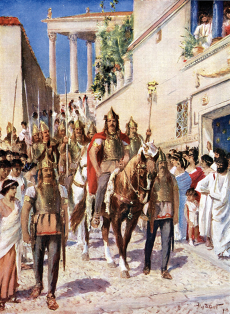
The Visigoths under King Alaric I crossed the Julian Alps and descended into the Po Valley of northern Italy in November 401 AD, opening a campaign that would shake the foundations of the Western Roman Empire. Alaric had been a Roman ally and military commander before his relationship with the imperial court deteriorated. Now he led his people as both a king seeking a homeland and a general seeking leverage. The invasion was not a barbarian raid in the popular sense. The Visigoths were a confederation of Gothic peoples who had lived within or near the Roman frontier for decades. Many had served in the Roman army. Alaric himself held a Roman military title. What he wanted was not Rome's destruction but a permanent settlement and an official military command for his people. The empire's refusal to provide either drove the conflict. The Roman general Stilicho, himself of Vandal descent, rallied the Western army to meet Alaric. He withdrew legions from the Rhine frontier and from Britain, weakening Roman defenses in those regions to concentrate forces in Italy. He confronted Alaric at the Battle of Pollentia on Easter Day 402, achieving a tactical draw that forced Alaric to withdraw from Italy temporarily. But the damage was strategic. The withdrawal of troops from the Rhine left that frontier exposed. Within five years, a massive crossing of Vandals, Suevi, and Alans across the frozen Rhine in December 406 would overwhelm the weakened defenses and begin the permanent loss of Roman control over Gaul and Spain. Alaric returned to Italy in 408, after Stilicho was executed by Emperor Honorius on suspicion of treason. Without Stilicho's military leadership, the Western Empire had no effective response. Alaric besieged Rome three times. On August 24, 410, the Visigoths entered the city. The sack of Rome, the first time the city had been taken by a foreign enemy in eight hundred years, sent shockwaves across the Mediterranean. Saint Jerome, writing from Bethlehem, said: "The city which had taken the whole world was itself taken."
November 18, 401
1625 years ago
What Else Happened on November 18
Elisha P. Ferry was inaugurated as the first governor of Washington State, just days after it was admitted to the Union as the 42nd state. Ferry, a Republican w…
Emperor Constantine's massive basilica over St. Peter's burial site was consecrated after nearly two decades of construction. The church became the spiritual ce…
Pope Urban II opened the Council of Clermont on November 18, 1095, delivering a sermon nine days later that called on European Christians to take up arms and re…
Roman aristocrats elected Maginulfo as Antipope Sylvester IV, directly challenging the authority of Pope Paschal II. This move intensified the Investiture Contr…
Maginulfo was installed as Antipope Sylvester IV by the Holy Roman Emperor's faction during the Investiture Controversy. His brief, contested papacy reflected t…
Philip II became king of France at age 15 and spent the next 43 years transforming a modest feudal kingdom into Europe's strongest monarchy. He tripled royal te…
Talk to History
Have a conversation with historical figures who witnessed this era. Ask questions, explore perspectives, and bring history to life.