Gonzales Fires First Shot: Texas Revolution Begins
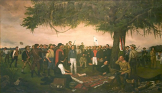
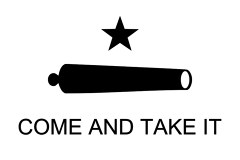
"Come and take it." Those four words, painted on a flag beside a crude cannon image, flew over eighteen Texian settlers who refused to return a small bronze cannon to the Mexican army. On October 2, 1835, the first shots of the Texas Revolution rang out near the Guadalupe River at Gonzales, and a decade of escalating tension between American colonists and the Mexican government erupted into open warfare. The cannon itself was almost comically insignificant — a six-pounder that the Mexican government had lent to Gonzales colonists in 1831 for defense against Comanche raids. When political relations deteriorated after General Antonio López de Santa Anna consolidated power and abolished the 1824 Constitution, military commander Colonel Domingo de Ugartechea sent a detachment of roughly 100 dragoons to reclaim the weapon. The request was reasonable by any military standard, but Gonzales settlers saw it as a test of whether Mexico would disarm its colonists ahead of a crackdown. The settlers buried the cannon, delayed the soldiers with stalling tactics, and sent riders to neighboring communities for reinforcements. By the time Lieutenant Francisco de Castañeda's dragoons arrived at the fog-shrouded Guadalupe River crossing on the morning of October 2, approximately 150 Texian militia had assembled under Colonel John Henry Moore. Castañeda attempted to negotiate. The Texians fired. The skirmish itself lasted perhaps twenty minutes and produced only one Mexican casualty. Castañeda withdrew his forces to San Antonio. But the political consequences dwarfed the military action. Within weeks, Texian forces besieged San Antonio de Béxar, captured the Alamo complex, and formed a provisional government. Stephen F. Austin, who had long counseled patience and negotiation, accepted command of the volunteer army. The confrontation at Gonzales ignited a revolution that would produce the Republic of Texas within six months and American annexation within a decade, reshaping the map of North America.
October 2, 1835
191 years ago
Key Figures & Places
What Else Happened on October 2
Angry crowds rioted at the Goose Fair in Nottingham in 1766, overturning cheese stalls and attacking merchants who had raised prices beyond what working familie…
Saladin's army had surrounded Jerusalem for 12 days when Balian of Ibelin offered surrender terms: let Christians leave safely or we'll destroy the Dome of the …
Theophilos became Byzantine Emperor at age 25 after his father Michael II died. He continued his father's iconoclasm—destroying religious images, persecuting ic…
Otto I shatters the rebel coalition led by Eberhard of Franconia at the Battle of Andernach, crushing their bid to overthrow his authority. This decisive victor…
Eighty-eight years of Crusader rule ended not with a massacre but with a negotiation. On October 2, 1187, Saladin's army entered Jerusalem after a twelve-day si…
King Haakon IV of Norway sent a fleet to Scotland to reclaim the Hebrides. His longships met Scottish forces at Largs in a storm. The battle was chaotic, indeci…
Talk to History
Have a conversation with historical figures who witnessed this era. Ask questions, explore perspectives, and bring history to life.