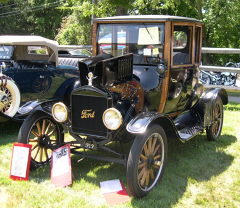
Ford Launches Model T: Cars for Everyone
For $850 — roughly $28,000 today — a schoolteacher, a farmer, or a factory worker could suddenly own a machine that had been the exclusive plaything of millionaires. The Ford Model T, introduced on October 1, 1908, didn't just democratize the automobile; it obliterated the class barrier that separated horse-drawn America from the motorized future. Henry Ford had spent five years and nineteen alphabetical prototypes working toward a single obsession: a car tough enough for rutted country roads, simple enough for its owner to repair, and cheap enough to sell by the millions. The Model T delivered on every count. Its vanadium steel frame was lighter and stronger than anything competitors offered. Its engine ran on gasoline, kerosene, or ethanol. Its planetary transmission required no shifting expertise, a radical departure from the crash gearboxes that demanded a chauffeur's skill. Early production at the Piquette Avenue plant in Detroit turned out about 11,000 cars in the first full year. Then Ford and his engineers introduced the moving assembly line in 1913, and everything changed. Build time per car plummeted from over twelve hours to ninety-three minutes. As efficiency climbed, the price fell — to $550 by 1915, then below $300 by the mid-1920s. Ford passed savings directly to buyers, creating a feedback loop: cheaper cars meant more buyers, more buyers meant higher volume, and higher volume meant even cheaper cars. By the time the fifteen millionth Model T rolled off the Highland Park line on May 26, 1927, the car had reshaped American geography, culture, and commerce. Suburbs sprawled outward. Gas stations, motels, and roadside diners sprang up along new highways. The middle class discovered the weekend road trip. Ford's $5-a-day wage — double the industry standard — gave his own workers the purchasing power to buy what they built, anticipating the consumer economy that would define the twentieth century. The Model T proved that manufacturing innovation could be as transformative as the product itself.
October 1, 1908
118 years ago
Key Figures & Places

What Else Happened on October 1
Three hundred thousand Persian soldiers held the plain near modern-day Mosul, their ranks bolstered by war elephants, scythed chariots, and cavalry drawn from e…
Damasus I became pope on October 1, 366 after his supporters killed 137 followers of his rival Ursinus in a three-day street battle. Both men claimed election. …
During a siege, worshippers packed into the Blachernae church saw the Virgin Mary appear above them, holding her veil over the congregation. St. Andrew witnesse…
Edgar the Peaceable became king of all England in 959 at age 16, but he'd already been king of Mercia for two years. His brother had ruled the south and died my…
John XIII became pope on October 1, 965 after Emperor Otto I forced the Roman nobles to elect him. The nobles hated it. They kidnapped John three months later, …
Gerard de Ridefort fell in battle outside the walls of Acre, ending a contentious five-year tenure as Grandmaster of the Knights Templar. His death during the T…
Talk to History
Have a conversation with historical figures who witnessed this era. Ask questions, explore perspectives, and bring history to life.