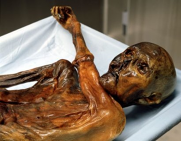
Otzi Discovered: Iceman Reveals Prehistoric Secrets
Two German hikers descending from the Fineilspitze peak in the Otztal Alps on September 19, 1991, noticed what appeared to be a human body melting out of the ice at an elevation of 10,530 feet on the Austrian-Italian border. Helmut and Erika Simon assumed they had found a recently deceased mountaineer. The corpse turned out to be more than 5,300 years old, the best-preserved prehistoric human ever discovered and a window into Copper Age Europe so detailed that scientists could reconstruct his last meals, his health problems, and the violent manner of his death. Otzi, as he was named after the mountain range where he was found, had been naturally mummified by the alpine ice and snow that covered him shortly after his death around 3300 BC. His skin, organs, bones, and even the contents of his stomach survived intact. He was approximately forty-five years old, five feet three inches tall, and suffered from arthritis, whipworm parasites, and Lyme disease. His body bore over sixty tattoos, clusters of lines and crosses concentrated near his joints and spine, which researchers believe may have been therapeutic, possibly an early form of acupuncture. The artifacts found with him were equally extraordinary. He carried a copper axe, a flint knife, a bow and arrows, a birch-bark container holding embers wrapped in maple leaves for starting fires, and clothing made from the skins of at least five different animal species. His equipment revealed a level of technological sophistication that challenged assumptions about Copper Age life, and the copper axe suggested he held high social status. The most dramatic discovery came in 2001, when an X-ray revealed an arrowhead lodged in his left shoulder. Otzi had been shot from behind, and the arrow severed a subclavian artery, causing him to bleed to death. DNA analysis of blood found on his weapons and clothing matched at least four other individuals, suggesting he had been in close combat with multiple attackers before his death. The Iceman was not a lost shepherd caught in a storm but the victim of a murder over five millennia ago, now housed in a custom-built museum in Bolzano, Italy, kept in a climate-controlled chamber at minus 6 degrees Celsius.
September 19, 1991
35 years ago
Key Figures & Places

What Else Happened on September 19
The Roman Senate declared Nerva emperor immediately following Domitian’s assassination, ending the Flavian dynasty’s autocratic grip on power. By ordering the d…
Constantine I elevated his nephew Flavius Dalmatius to the rank of Caesar, granting him administrative control over Thrace, Macedonia, and Achaea. This promotio…
The ancient city of Damascus, one of the oldest continuously inhabited cities in the world, fell to the armies of the Rashidun Caliphate on September 19, 634, a…
Edward the Black Prince had around 8,000 men and was trying to retreat when the French king John II decided to charge instead of wait. The English longbowmen sh…
The Teutonic Order's State successfully repels the combined Polish-Lithuanian assault, ending the siege and preserving their control over Marienburg for another…
Nathaniel Bacon’s rebels torched Jamestown, compelling Governor William Berkeley to flee across the Chesapeake Bay. This destruction ended the colony’s first ca…
Talk to History
Have a conversation with historical figures who witnessed this era. Ask questions, explore perspectives, and bring history to life.