

Viking 2 Lands on Mars: Red Planet Explored
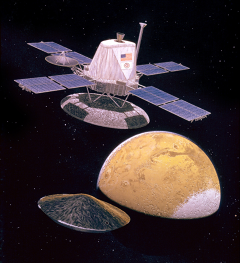
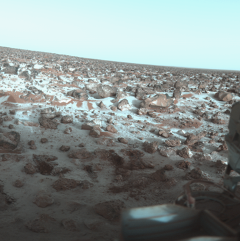
NASA's Viking 2 lander touched down on the Utopia Planitia plain on September 3, 1976, becoming the second spacecraft to successfully land on Mars and operate on the surface. The landing site, chosen for its relatively flat terrain in the planet's northern hemisphere, sat roughly 6,500 kilometers from where Viking 1 had landed seven weeks earlier, giving scientists their first opportunity to compare conditions at two widely separated points on another planet. Viking 2 transmitted images of a rust-colored rocky landscape stretching to a horizon only three kilometers away under a salmon-pink sky. Both Viking landers carried identical instruments designed primarily to search for signs of life in the Martian soil. The biology experiments produced results that remain debated to this day. The labeled release experiment, designed by Gilbert Levin, detected chemical activity in soil samples that closely mimicked the signature expected from living microorganisms. However, the gas chromatograph-mass spectrometer found no organic molecules in the soil, leading most scientists to conclude that the reactions were caused by highly oxidizing chemicals in the Martian regolith rather than biology. Viking 2 operated far longer than its designed 90-day mission, continuing to return data until April 1980 when its batteries failed. During its operational life, the lander recorded Martian weather patterns, including the first observations of frost on the planet's surface. The thin white layer of water-ice frost that appeared on the rocks and soil around the lander during the Martian winter provided direct visual evidence of the water cycle that subsequent missions would investigate in far greater detail. The Viking program cost approximately $1 billion in 1970s dollars, making it the most expensive planetary mission NASA had attempted. No spacecraft would successfully return to the Martian surface for another 21 years, until Mars Pathfinder landed in 1997. The Viking missions established the baseline understanding of Mars that every subsequent rover and lander has built upon.
September 3, 1976
50 years ago
Key Figures & Places





What Else Happened on September 3
Agrippa's fleet destroyed Sextus Pompeius's armada at Naulochus off the coast of Sicily, sinking or capturing nearly all 300 enemy ships in a single afternoon. …

A Christian stonemason fleeing religious persecution on the Dalmatian coast climbed Monte Titano on September 3, 301 AD, and founded a small community of fellow…
Gregory didn't want the job. He'd been living as a monk, and when the previous pope died of plague, Gregory tried to flee Rome to avoid being chosen. He was cau…
Visigothic King Wamba marched his army into southern Gaul and crushed the rebellion of Hilderic, the governor of Nimes who had seized power with local support. …
The Arab emir Umar al-Aqta had been raiding deep into Byzantine Anatolia for years, and the Byzantines had had enough. At the Lalakaon River in 863, a Byzantine…

Richard I was crowned King of England at Westminster Abbey on September 3, 1189, in a ceremony so charged with religious fervor and military ambition that it tr…
Talk to History
Have a conversation with historical figures who witnessed this era. Ask questions, explore perspectives, and bring history to life.