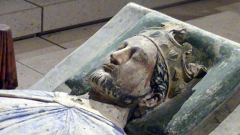
Richard the Lionheart Crowned: Crusade King Takes Throne
Richard I was crowned King of England at Westminster Abbey on September 3, 1189, in a ceremony so charged with religious fervor and military ambition that it triggered the first major pogrom against England's Jewish community. The new king, already renowned across Europe as a warrior who had spent his youth fighting in France, took the crown with the immediate intention of leaving England to lead the Third Crusade. He would spend fewer than six months of his ten-year reign on English soil, earning the epithet "Lionheart" through feats of arms in the Holy Land rather than any act of governance at home. Richard's coronation was marred by anti-Jewish violence that erupted the same day. Jewish leaders who came to Westminster bearing gifts for the new king were barred from the ceremony, and a rumor spread that Richard had ordered an attack on the Jews. Mobs descended on London's Jewish quarter, burning homes and killing an unknown number of residents. The violence spread to York, Norwich, and other cities over the following months, culminating in the mass suicide and massacre at Clifford's Tower in York in March 1190, where approximately 150 Jews died. Richard punished some of the perpetrators but was primarily concerned with financing his crusade rather than protecting his Jewish subjects. The Third Crusade consumed Richard's attention and his treasury from the moment he took the crown. He sold offices, castles, and entire towns to raise funds, allegedly remarking that he would have sold London itself if he could have found a buyer. He departed for the Holy Land in 1190 and won a series of dramatic victories, including the capture of Acre and the Battle of Arsuf, where his personal bravery became legendary. He never recaptured Jerusalem but negotiated a treaty with Saladin that preserved Christian access to the holy sites. Richard died in 1199 from a crossbow wound sustained while besieging a minor French castle, an end strangely unheroic for a king whose entire identity was forged in battle. His legend, amplified by troubadour songs and later by the Robin Hood tradition, far outlived the reality of a king who treated England primarily as a source of revenue for foreign wars.
September 3, 1189
837 years ago
Key Figures & Places
What Else Happened on September 3
Agrippa's fleet destroyed Sextus Pompeius's armada at Naulochus off the coast of Sicily, sinking or capturing nearly all 300 enemy ships in a single afternoon. …
A Christian stonemason fleeing religious persecution on the Dalmatian coast climbed Monte Titano on September 3, 301 AD, and founded a small community of fellow…
Gregory didn't want the job. He'd been living as a monk, and when the previous pope died of plague, Gregory tried to flee Rome to avoid being chosen. He was cau…
Visigothic King Wamba marched his army into southern Gaul and crushed the rebellion of Hilderic, the governor of Nimes who had seized power with local support. …
The Arab emir Umar al-Aqta had been raiding deep into Byzantine Anatolia for years, and the Byzantines had had enough. At the Lalakaon River in 863, a Byzantine…
The Mamluk cavalry of Egypt smashed into the Mongol army at Ain Jalut in the Jezreel Valley of Palestine on September 3, 1260, inflicting the first decisive def…
Talk to History
Have a conversation with historical figures who witnessed this era. Ask questions, explore perspectives, and bring history to life.