

Mamluks Crush Mongols at Ain Jalut: Expansion Halted
The Mamluk cavalry of Egypt smashed into the Mongol army at Ain Jalut in the Jezreel Valley of Palestine on September 3, 1260, inflicting the first decisive defeat on a military force that had seemed invincible for four decades. The Mongol Empire, which had conquered everything from China to Eastern Europe, met its match against slave-soldiers who fought with a desperation born of knowing that defeat meant annihilation. Mamluk Sultan Qutuz and his brilliant general Baibars destroyed virtually the entire Mongol force, killing its commander Kitbuqa and halting Mongol expansion into Africa and the remaining Muslim heartlands. The Mongol army at Ain Jalut was smaller than the forces that had sacked Baghdad two years earlier, when Hulagu Khan's horde killed the Abbasid Caliph and an estimated 200,000 to two million inhabitants in one of history's most devastating sieges. Hulagu had withdrawn most of his army eastward following the death of Great Khan Mongke, leaving a garrison force under Kitbuqa to hold Syria. The Mamluks, who had recently seized power in Egypt through a palace coup, recognized this moment of Mongol weakness and struck. Baibars executed a tactical masterpiece, using a small advance force to lure the Mongols into a pursuit while the main Mamluk army waited in concealment among the hills. When the Mongols charged after Baibars, Qutuz sprung the trap, enveloping the enemy from three sides. The Mongols, accustomed to using this exact tactic against others, found themselves surrounded and systematically destroyed. Kitbuqa fought to the death rather than retreat. Ain Jalut preserved Egypt, North Africa, and the western Islamic world from Mongol conquest. The Mamluks went on to expel the remaining Crusader states from the Levant and dominated the region for the next two and a half centuries. The battle demonstrated that the Mongol military machine, though extraordinary, was not supernatural, and it encouraged resistance across the Islamic world that ultimately confined the Mongol successor states to Central and East Asia.
September 3, 1260
766 years ago
Key Figures & Places
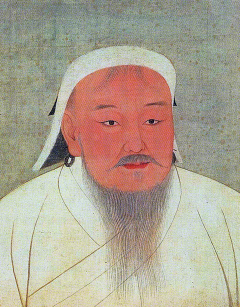
Mongols
Wikipedia
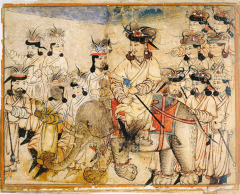
Mongol Empire
Wikipedia
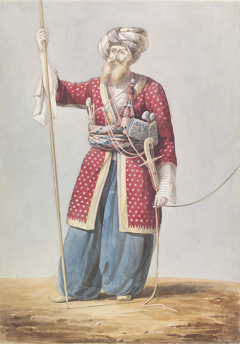
Mamluks
Wikipedia
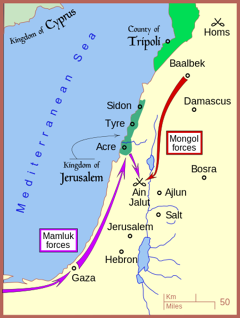
Battle of Ain Jalut
Wikipedia
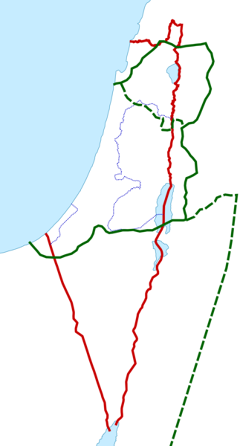
Palestine (region)
Wikipedia

Mamluk
Wikipedia

Mongols
Wikipedia

Battle of Ain Jalut
Wikipedia

Palestine (region)
Wikipedia

Mongol Empire
Wikipedia

Armée mongole
Wikipedia
Yuanshi (Geschichtswerk)
Wikipedia

Mamluk Sultanate
Wikipedia
What Else Happened on September 3
Agrippa's fleet destroyed Sextus Pompeius's armada at Naulochus off the coast of Sicily, sinking or capturing nearly all 300 enemy ships in a single afternoon. …

A Christian stonemason fleeing religious persecution on the Dalmatian coast climbed Monte Titano on September 3, 301 AD, and founded a small community of fellow…
Gregory didn't want the job. He'd been living as a monk, and when the previous pope died of plague, Gregory tried to flee Rome to avoid being chosen. He was cau…
Visigothic King Wamba marched his army into southern Gaul and crushed the rebellion of Hilderic, the governor of Nimes who had seized power with local support. …
The Arab emir Umar al-Aqta had been raiding deep into Byzantine Anatolia for years, and the Byzantines had had enough. At the Lalakaon River in 863, a Byzantine…

Richard I was crowned King of England at Westminster Abbey on September 3, 1189, in a ceremony so charged with religious fervor and military ambition that it tr…
Talk to History
Have a conversation with historical figures who witnessed this era. Ask questions, explore perspectives, and bring history to life.