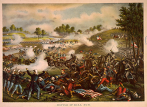
Bull Run Chaos: Civil War's First Real Battle
Spectators from Washington packed picnic baskets and rode carriages to the hills above Manassas Junction, expecting to watch the Union army crush the rebellion in an afternoon. What they witnessed instead was a rout that sent soldiers and civilians alike stampeding back toward the capital in a tangled mass of abandoned wagons and shattered confidence. Union General Irvin McDowell led roughly 35,000 poorly trained volunteers against a Confederate force of similar size commanded by Generals Beauregard and Johnston near a small Virginia creek called Bull Run. Both armies were green, their officers largely untested, and the battle plan relied on coordination that raw troops simply could not execute. McDowell initially pushed the Confederates back on the left flank, but reinforcements arrived by rail from the Shenandoah Valley throughout the day. The turning point came on Henry House Hill, where Brigadier General Thomas Jackson held his Virginia brigade in a rigid defensive line while other Confederate units rallied around him. General Bee, trying to steady his own retreating men, pointed toward Jackson and reportedly shouted that he stood "like a stone wall," giving Jackson the nickname he would carry through the war. A fierce counterattack drove the Union troops off the hill, and what began as an orderly withdrawal became a panicked flight when a destroyed bridge created a bottleneck on the road to Washington. The battle killed roughly 900 men on both sides and wounded thousands more. Northern newspapers that had printed triumphant headlines the morning before now demanded answers. The fantasy of a quick war dissolved overnight. Congress authorized the enlistment of one million volunteers, and Lincoln replaced McDowell with George McClellan, beginning the long and bloody search for a general who could win. Bull Run taught both nations the same brutal lesson: this war would not end with a single afternoon of fighting.
July 21, 1861
165 years ago
Key Figures & Places
What Else Happened on July 21
A man whose name the ancient world tried to erase succeeded in becoming immortal anyway. Herostratus, an otherwise unremarkable citizen of Ephesus, set fire to …
Pontian ascended to the papacy, inheriting a church still navigating the precarious legal status of Christianity within the Roman Empire. His five-year tenure e…
Diocletian elevated his fellow soldier Maximian to the rank of Caesar, splitting the Roman Empire’s administration between East and West. This pragmatic power-s…
The wave arrived on a summer morning, July 21st, 365 AD. No warning. Alexandria's harbor emptied first—the sea pulled back, exposing shipwrecks and fish floppin…
A massive earthquake struck Crete with extreme intensity, triggering a catastrophic tsunami that devastated the Mediterranean coastline. The surge obliterated A…
King Berengar I and his Hungarian allies crush Frankish forces at Verona, capturing Louis III to enforce a brutal penalty: blinding him for breaking his oath. T…
Talk to History
Have a conversation with historical figures who witnessed this era. Ask questions, explore perspectives, and bring history to life.