Perfect 10: Comaneci Rewrites Olympic Gymnastics
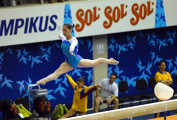
The scoreboard at the Montreal Forum could not display the number. When fourteen-year-old Nadia Comaneci dismounted from the uneven bars on July 18, 1976, the judges awarded the first perfect 10.0 in Olympic gymnastics history, but the Omega electronic scoreboard had not been programmed for perfection. It showed 1.00 instead, and the crowd sat confused until the announcer explained that the tiny Romanian had just done something no gymnast had ever accomplished in Olympic competition. Comaneci had been training since age six under the exacting coach Béla Károlyi in the small Romanian city of Onesti. Károlyi's methods were revolutionary and brutal. He recruited children as young as five, trained them six hours a day, controlled their diets, and pushed them through injuries. Comaneci was his masterpiece: a 4-foot-11, 86-pound athlete with extraordinary spatial awareness, nerves of steel, and a blank-faced composure that television cameras found mesmerizing. She had won the European Championship at thirteen, but nothing prepared the world for Montreal. Her uneven bars routine that first evening was technically flawless: a series of release moves, kips, and transitions executed with mechanical precision and not a single visible error in balance, form, or landing. The judges had no choice. Four more times during the Montreal Games, Comaneci received a 10.0, finishing with three gold medals (all-around, uneven bars, balance beam), one silver, and one bronze. She was the youngest all-around champion in Olympic history and the dominant story of the 1976 Games, eclipsing even the men's competition. The Montreal performance transformed gymnastics from a niche sport into a global television spectacle and triggered a wave of enrollment in gymnastics programs worldwide. Comaneci's legacy is complicated by the system that produced her. Romanian gymnastics under Károlyi and the Ceausescu regime subjected young athletes to extreme physical and psychological pressure. Comaneci herself defected from Romania in 1989, weeks before the revolution that overthrew Ceausescu. She settled in the United States and became an advocate for the sport, though the era she defined also planted the seeds of the abuse scandals that would consume elite gymnastics decades later.
July 18, 1976
50 years ago
Key Figures & Places

What Else Happened on July 18
The Etruscan city of Veii lured the Fabian clan into a lethal trap at the Cremera River, annihilating the entire Roman force. This disaster nearly wiped out one…
The Gauls covered fifteen miles in a single day after their victory—no stopping, no camp, straight to an undefended Rome. At the Allia River, Roman commanders p…
Raiding Gauls crushed a Roman army at the Allia River, scattering the defenders and leaving Rome completely unprotected for the first time in the republic's his…
Fire erupted in the shops clustered around the Circus Maximus on July 18, 64 AD, and for six days the flames consumed the densest neighborhoods of the ancient w…
Sixty thousand men crammed into Antioch for nine months while Julian planned his Persian invasion. The city couldn't handle it. Food prices tripled. Brothels ov…
Attila the Hun besieged and razed Aquileia to the ground, wiping out one of the wealthiest cities in the Western Roman Empire after weeks of relentless assault.…
Talk to History
Have a conversation with historical figures who witnessed this era. Ask questions, explore perspectives, and bring history to life.