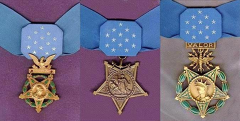
Medal of Honor Created: Congress Honors the Bravest
Congress created the nation's highest award for military valor during the darkest months of the Civil War, establishing a decoration that would become the most coveted and carefully guarded honor in American military history. President Abraham Lincoln signed legislation on July 12, 1862, authorizing the Army Medal of Honor, following the Navy version approved in December 1861. The creation reflected both a genuine desire to recognize extraordinary courage and a practical need to boost morale in an army suffering devastating losses. The United States had resisted creating military decorations since the Revolution, viewing them as relics of European aristocracy. George Washington established the Badge of Military Merit in 1782, but the tradition lapsed. For eighty years, American soldiers received no official recognition for bravery beyond mention in dispatches. The scale of Civil War combat, with its massive volunteer armies and staggering casualties, demanded something more tangible. Early standards for the medal were loose by modern criteria. During the Civil War, 1,522 medals were awarded, some for actions that would not meet today's requirements of conspicuous gallantry above and beyond the call of duty. The entire 27th Maine Infantry received medals simply for extending their enlistment by four days. In 1917, a review board revoked 911 medals, including those of the Maine regiment and the five civilian scouts, among them Buffalo Bill Cody. Modern standards, codified after World War I, require incontrovertible proof of valor so extraordinary that it clearly distinguishes the recipient from comrades. The review process involves multiple levels of command verification, and fewer than twenty have been awarded in conflicts since Vietnam. Recipients receive a monthly pension, their children gain automatic admission to military academies, and they are saluted by all ranks, including the president. Roughly 3,500 have been awarded since 1862, and each carries the weight of actions that most soldiers consider beyond human expectation.
July 12, 1862
164 years ago
Key Figures & Places
What Else Happened on July 12
Titus's legions smashed through Jerusalem's battered walls three days after breaching the outer perimeter, unleashing a fire that consumed the Second Temple and…
King Æthelstan of England secured the submission of Scotland's Constantine II, Wales' Hywel Dda, and northern leaders Ealdred and Owain at a meeting that ended …
England's first true king forced every rival power in Britain to bend the knee at a single gathering, forging a political unity the island had not seen since th…
Saladin’s garrison surrendered Acre to King Philip II of France, concluding a brutal two-year siege that claimed thousands of lives. This victory secured a vita…
Pope Benedict XII issued the papal bull Fulgens sicut stella matutina on July 12, 1335, to enforce stricter discipline within the Cistercian Order. This decree …
The Venetians called it Negroponte—their richest colony, holding the narrows between mainland Greece and Euboea. Sultan Mehmed II brought 100,000 men and siege …
Talk to History
Have a conversation with historical figures who witnessed this era. Ask questions, explore perspectives, and bring history to life.