Bridge to the Future: Golden Gate Connects San Francisco
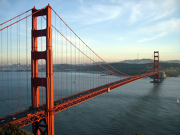
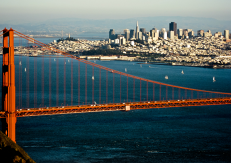
The opening day was for pedestrians. Two hundred thousand San Franciscans walked across the Golden Gate Bridge on May 27, 1937, celebrating with footraces, roller skating, and a brass band. On May 28, President Roosevelt pressed a telegraph key from the White House, and vehicle traffic began crossing the span that engineers had insisted could not be built. The bridge connected San Francisco to Marin County across a strait notorious for violent currents, deep water, and dense fog. Chief engineer Joseph Strauss overcame opposition from ferry companies, the War Department, and the Southern Pacific Railroad, all of which profited from the strait remaining unbridged. Financing came through a $35 million bond issue approved by voters in six counties during the Great Depression. Construction took four years and four months. Workers drove the south pier's foundation into the ocean floor 1,100 feet from shore, inside a massive concrete fender that was repeatedly damaged by storms and ship collisions during construction. The main cables, each containing 27,572 individual wires, were spun in place by a system that sent wire loops back and forth across the towers. The bridge's Art Deco towers rise 746 feet above the water, and the roadway hangs 220 feet above the strait at center span, high enough for the largest ships to pass beneath. Consulting architect Irving Morrow chose International Orange for the color, originally intended as a primer but so striking that it became permanent. Eleven men died during construction. Joseph Strauss had insisted on a safety net below the roadway that saved 19 workers from fatal falls. The "Halfway to Hell Club," composed of saved workers, became a symbol of the project's commitment to worker safety. The Golden Gate Bridge was the longest suspension bridge in the world for 27 years and remains the most photographed bridge on Earth. Its completion proved that public infrastructure built during economic crisis could be finished on time and under budget, a lesson governments have struggled to replicate since.
May 28, 1937
89 years ago
Key Figures & Places
What Else Happened on May 28
The sun went dark mid-battle, and both armies dropped their weapons. Thales of Miletus had predicted it—the first recorded solar eclipse forecast in history, Ma…
Li Shimin had 3,500 cavalry. Dou Jiande brought 100,000 men to Hulao Pass in Henan. The numbers didn't matter. Shimin's father had just founded the Tang Dynasty…
They murdered the inquisitors in their sleep. William Arnaud and eleven companions were hunting heretics in Languedoc when Cathars stormed their lodgings at Avi…
They called it "everlasting." James IV of Scotland married Margaret Tudor in 1503, her father Henry VII footing the bill for a wedding that cost more than Scotl…
Cranmer didn't even have the authority yet—his papal bulls confirming him as Archbishop wouldn't arrive for another two months. But Henry needed this marriage l…
King Philip II assembled the largest naval force Europe had ever seen and sent it to conquer England. The English Channel destroyed it. The Spanish Armada saile…
Talk to History
Have a conversation with historical figures who witnessed this era. Ask questions, explore perspectives, and bring history to life.