Second Congress Meets: Colonies Unite Against Britain
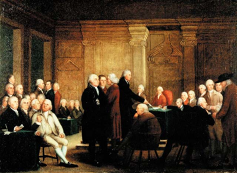
Delegates from twelve colonies gathered at the Pennsylvania State House in Philadelphia on May 10, 1775, three weeks after British soldiers and colonial militiamen had exchanged fire at Lexington and Concord. The Second Continental Congress convened without a clear mandate, without legal authority, and without consensus on whether to seek reconciliation with Britain or prepare for independence. Over the next sixteen months, it became the government of a revolution. The First Continental Congress had met the previous fall and adopted a boycott of British goods. Most delegates expected the boycott to produce negotiations. The bloodshed in Massachusetts changed everything. By May, colonial militias were besieging British troops in Boston, and the delegates arriving in Philadelphia faced a war that had started without their authorization. The Congress included some of the most talented political minds in the colonies. John and Samuel Adams came from Massachusetts, Benjamin Franklin from Pennsylvania, George Washington from Virginia. New members included Thomas Jefferson, who arrived in June, and John Hancock, who was elected president of the Congress after Peyton Randolph returned to Virginia. The body had no constitutional basis, no power to tax, and no ability to enforce its resolutions. Nevertheless, the Congress began acting as a national government almost immediately. On June 14, it created the Continental Army. On June 15, it appointed George Washington as commander-in-chief, choosing a Virginia planter to lead what was still largely a New England army, a political calculation designed to ensure Southern support for the war. Washington departed for Boston within days. The Congress also issued paper money, established a postal system, created a committee to negotiate with foreign powers, and sent the Olive Branch Petition to King George III as a last attempt at reconciliation. The king refused to receive it and declared the colonies in open rebellion. By July 1776, the Congress had moved from reluctant war management to declaring independence, creating a new nation through an act of collective political will that had no precedent in the modern world.
May 10, 1775
251 years ago
Key Figures & Places
What Else Happened on May 10
The Han astronomers didn't call it a sunspot. They recorded a black vapor within the sun—specific enough to measure its position, detailed enough to date: 28 BC…
Four Roman legions and 80,000 soldiers arrived at the walls of Jerusalem in the spring of 70 AD, and Titus, the emperor's son and field commander, launched his …
Scottish nobles gathered at Norham to acknowledge Edward I as their feudal overlord, hoping he would settle the chaotic succession crisis following the death of…
Temür Khan ascended the throne as the second Yuan emperor, securing his power after a brief succession struggle following Kublai Khan’s death. His reign stabili…
Amerigo Vespucci departed Cádiz on his first expedition across the Atlantic, aiming to map the coastlines of the Americas. His subsequent letters describing the…
Columbus sailed past two small Caribbean islands and couldn't stop talking about the turtles. Thousands of them. Maybe tens of thousands crawling across beaches…
Talk to History
Have a conversation with historical figures who witnessed this era. Ask questions, explore perspectives, and bring history to life.