Hindenburg Burns: The Airship Era Ends
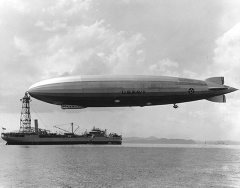
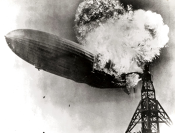
Thirty-six seconds. That is how long it took for the largest flying object ever built to transform from a symbol of technological triumph into a burning skeleton of aluminum framing over the landing field at Lakehurst Naval Air Station in New Jersey. The Hindenburg disaster on May 6, 1937, killed 36 of the 97 people aboard and one ground crew member, and it destroyed public confidence in rigid airship travel permanently. The LZ 129 Hindenburg was 804 feet long, nearly the length of the Titanic, and held 7 million cubic feet of hydrogen gas in sixteen cells within its duralumin frame. The Zeppelin Company had wanted to use nonflammable helium, but the United States, the only commercial producer, had embargoed helium exports to Nazi Germany. Hydrogen was lighter and provided better lift, but it was catastrophically flammable. The airship had completed ten successful round trips between Frankfurt and Lakehurst in 1936. On this flight, its first of the 1937 season, the Hindenburg arrived over Lakehurst on the evening of May 6 carrying 36 passengers and 61 crew. Captain Max Pruss circled the field for over an hour waiting for a thunderstorm to pass before beginning his approach. At 7:25 PM, as ground handlers grabbed the mooring lines, witnesses saw a small flame near the top of the tail section. Within seconds, the hydrogen ignited in a chain reaction that consumed the ship from stern to bow. Radio broadcaster Herbert Morrison, recording a routine arrival for WLS Chicago, captured the destruction in real time. His anguished narration, "Oh, the humanity!" became one of the most recognized phrases in broadcast history. The cause remains debated. Leading theories include static discharge igniting a hydrogen leak, a structural bracing wire snapping and puncturing a gas cell, or the flammability of the outer fabric's aluminum-doped coating. Whatever the ignition source, the disaster ended the age of rigid airships. Every major airline that had considered zeppelin service abandoned its plans within weeks.
May 6, 1937
89 years ago
Key Figures & Places

What Else Happened on May 6
Charles III, Duke of Bourbon, was killed by an arquebus shot while scaling the walls of Rome at dawn on May 6, 1527. His death should have ended the assault. In…
The Constable of Bourbon died in the first wave, shot off a scaling ladder before his unpaid army even reached Rome's walls. What followed wasn't a battle. For …
Manco Inca brought 100,000 warriors to reclaim Cuzco from roughly 200 Spanish defenders. The numbers weren't even close. But those 200 had horses, steel armor, …
The problem wasn't that most English people couldn't read Latin. It's that their priests couldn't either. Henry VIII's 1536 order for English Bibles in every ch…
For the first time, an English farmer could walk into his parish church and read God's words in his own language. Henry VIII—the same king who'd broken with Rom…
Francis Xavier arrived in Old Goa to begin a decade of Jesuit missionary work across Asia. His presence transformed the region into the administrative heart of …
Talk to History
Have a conversation with historical figures who witnessed this era. Ask questions, explore perspectives, and bring history to life.