
Pelletier Falls to Guillotine: France's New Execution Machine
Nicolas Jacques Pelletier, a highwayman convicted of robbery and murder, became the first person executed by guillotine in France on April 25, 1792, at the Place de Greve in Paris. The event drew a large crowd expecting the spectacular public death they were accustomed to under the old regime. They were disappointed. The blade fell, the head dropped, and it was over in a fraction of a second. Spectators, denied the prolonged suffering of traditional executions, reportedly grumbled that the new machine was too quick and chanted for the return of the wooden gallows. The guillotine was designed as an instrument of enlightenment. Dr. Joseph-Ignace Guillotin, a physician and member of the National Assembly, proposed in 1789 that all condemned prisoners, regardless of social class, should be executed by the same method and that the method should cause the least possible suffering. Under the ancien regime, aristocrats were beheaded by sword while commoners were hanged, broken on the wheel, or burned alive. Guillotin's proposal was a radical assertion of equality, even in death. The actual design was executed by Antoine Louis, secretary of the Academy of Surgery, with refinements by the German harpsichord maker Tobias Schmidt, who suggested the angled blade that became the machine's signature feature. Testing was conducted on corpses and live sheep at the Bicetre Hospital. The device worked exactly as intended: a weighted blade dropping from a height of approximately seven feet severed the head cleanly and instantaneously. Louis initially received credit, and the machine was briefly called the "Louison" before popular usage settled on "guillotine." Pelletier's execution was a prelude to industrial-scale killing. Within eighteen months, the Reign of Terror would send an estimated 16,594 people to the guillotine, including King Louis XVI and Queen Marie Antoinette. The machine designed to make death humane became the symbol of revolutionary excess, its efficiency enabling a volume of executions that would have been impossible with earlier methods. France continued to use the guillotine for capital punishment until 1977, when Hamida Djandoubi became the last person executed by the device. The death penalty was abolished in France in 1981.
April 25, 1792
234 years ago
Key Figures & Places
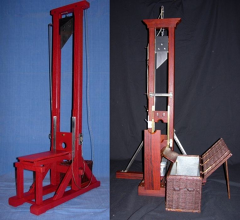
guillotine
Wikipedia
Highwayman
Wikipedia

Nicolas J. Pelletier
Wikipedia
Highwayman
Wikipedia
Nicolas Jacques Pelletier
Wikipedia
Guillotine
Wikipedia
Place de l'Hôtel-de-Ville - esplanade de la Libération
Wikipedia
Paris
Wikipedia
French Revolution
Wikipedia
Charles Henri Sanson
Wikipedia
La Marseillaise
Wikipedia
حرابة
Wikipedia
What Else Happened on April 25
Athens starved. After Lysander's Spartan fleet annihilated the Athenian navy at Aegospotami in 405 BC, capturing 170 of 180 warships and executing 3,000 prisone…
Rats were eating the last of Athens' grain when Sparta's fleet finally sealed the harbor in 404 BC. Admiral Lysander watched as King Pausanias tightened the noo…
Seven thousand Armenian nobles lay dead in the snow at Bagrevand on April 24, 775. The Armenian nakharar families had risen against the Abbasid Caliphate's incr…
Bloodied and blind, Pope Leo III scrambled out of Rome's streets in 799. Roman mobs had gouged his eyes and slashed his tongue, leaving him broken before he rea…
A bishop's decree turned a muddy riverbank into a spiritual capital. King Ladislaus didn't just sign the Felician Charter; he carved out the Zagreb Bishopric, p…
The Dutch fleet decimated the anchored Spanish navy at the Battle of Gibraltar, neutralizing Spain’s maritime dominance in the region. This decisive victory cri…
Talk to History
Have a conversation with historical figures who witnessed this era. Ask questions, explore perspectives, and bring history to life.