Greeks Enter Troy: The Horse Deceives a City
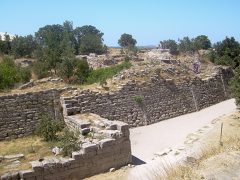
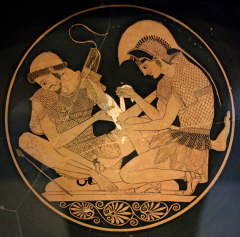
Greek soldiers crept out of a hollow wooden horse in the dead of night and opened the gates of Troy, ending a ten-year siege and launching one of the foundational stories of Western civilization. The traditional date for the fall of Troy is April 24, 1184 BC, as calculated by the ancient Greek scholar Eratosthenes. Whether the Trojan War actually happened, and if so what it looked like, remains one of archaeology's most fascinating and frustrating questions. The story as preserved in Homer's "Iliad" and later sources describes a massive Greek expedition to recover Helen, wife of King Menelaus of Sparta, who had eloped with or been abducted by Paris of Troy. The resulting war involved heroes like Achilles, Hector, Ajax, and Odysseus in a conflict that blended human ambition with divine interference. The Trojan Horse itself does not appear in the "Iliad," which ends before Troy's fall; the stratagem is described in the "Odyssey" and elaborated in later works, particularly Virgil's "Aeneid." Archaeological excavations at Hisarlik in northwestern Turkey, the site identified by Heinrich Schliemann in the 1870s as ancient Troy, have revealed a city that was destroyed and rebuilt multiple times over millennia. Troy VIIa, the layer dating to approximately 1180 BC, shows evidence of fire and possible conflict, aligning roughly with the traditional timeline. Whether this destruction was the work of Mycenaean Greeks, an earthquake, or some combination remains uncertain. The archaeological evidence confirms that a significant Bronze Age city existed at the site and was violently destroyed, but it cannot confirm the specific narrative of Homer's epic. The fall of Troy, historical or mythical, became the origin story for multiple civilizations. Rome traced its founding to the Trojan exile Aeneas. Medieval European kingdoms competed to claim Trojan ancestry. The "Iliad" and "Odyssey" shaped Greek education, ethics, and identity for a thousand years. The story's persistence speaks less to its historical accuracy than to its power as a narrative about war, loss, and the terrible costs of pride, themes that lose nothing for being 3,200 years old.
April 24, 1184 BC
Key Figures & Places
What Else Happened on April 24
A child inherited the throne of the most powerful empire on earth, and a woman ruled in his place for two decades. Thutmose III became pharaoh around 1479 BC up…
Ten years of siege, one wooden horse hiding two thousand Greeks. When the gates creaked open, Priam's palace burned and his sons fell by the sword. Helen walked…
Eratosthenes pinned 1183 BC as the day Greek ships burned twelve thousand men and women alive inside wooden walls. He didn't care about gods; he counted the dea…
Charles V's horse, Euphrosine, bolted right into a swamp, leaving the Emperor stranded in muddy water while his son-in-law, the Duke of Alba, charged straight t…
Mary, Queen of Scots, wed the Dauphin François at Notre Dame, uniting the French and Scottish crowns under a single Catholic alliance. This marriage intensified…
They didn't wait for permission to print news. In 1704, Richard Pierce launched the Boston News-Letter with just four pages of gossip and shipping logs. But ima…
Talk to History
Have a conversation with historical figures who witnessed this era. Ask questions, explore perspectives, and bring history to life.