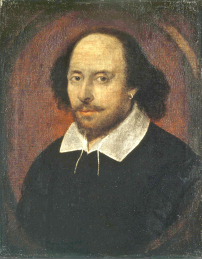
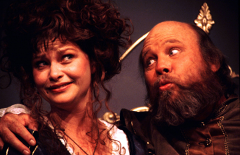
Shakespeare Debuts Merry Wives: Queen Elizabeth in Attendance
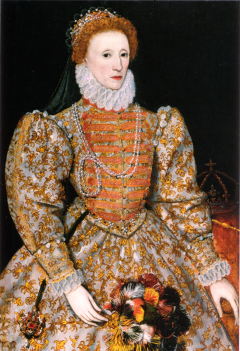
Queen Elizabeth I wanted to see the fat knight in love, and Shakespeare obliged. "The Merry Wives of Windsor" was reportedly written at the queen's command after she so enjoyed Sir John Falstaff in the "Henry IV" plays that she requested a comedy showing him romantically entangled. The play was first performed on April 23, 1597, likely at the Garter Feast at Westminster, for an audience that included the monarch herself. Legend holds that Shakespeare wrote it in fourteen days. Whether the fourteen-day timeline is true, the play reads like fast work, and Shakespeare seems to have known it. "The Merry Wives of Windsor" is his most English comedy, set entirely in the contemporary middle-class world of a provincial town rather than the Italian courts and enchanted forests of his other comedies. Falstaff, the brilliant, anarchic figure of the history plays, is here reduced to a buffoon who attempts to seduce two married women simultaneously to get at their husbands' money. The wives, Mistress Ford and Mistress Page, see through him immediately and spend the play humiliating him in increasingly elaborate ways. The play's real interest lies in its portrait of Elizabethan small-town life, a world of gossip, jealousy, social climbing, and petty rivalry rendered with an ethnographer's eye for detail. The language mixes prose and verse with characters speaking in Welsh, French, and Latin accents, producing a comic texture quite different from the lyrical wit of "A Midsummer Night's Dream" or "Much Ado About Nothing." Ford's pathological jealousy anticipates Othello. The merry wives's competence and agency anticipate no one, because Shakespeare rarely gave married, middle-class women this much control over a plot. "The Merry Wives of Windsor" has never been ranked among Shakespeare's greatest works, but it has remained continuously popular on stage for over four centuries. Verdi's opera "Falstaff," based primarily on the play, is considered one of the supreme achievements of comic opera. The play endures because it delivers exactly what Elizabeth apparently asked for: Falstaff made foolish by love, punished by clever women, and redeemed by communal laughter.
April 23, 1597
429 years ago
Key Figures & Places
What Else Happened on April 23
They built a shrine to a goddess of desire right after losing an army. In 215 BC, panic drove Rome's leaders to dedicate Venus Erycina on the Capitoline Hill fo…
A queen falls, not in battle's heat, but to a sack that turns stone to dust. In 599, Uneh Chan of Calakmul crushed Palenque's defenses, killing Queen Yohl Ik'na…
A seven-year-old boy in a wool tunic stood under a canopy while nobles held their breath. Dagobert III didn't rule; his father, Pepin II, did everything behind …
Dagobert III ascended to the Frankish throne following the death of his father, Childebert III. His reign deepened the decline of Merovingian authority, as the …
Brian Boru, the aging High King of Ireland, shattered Norse-Dublin power at Clontarf on April 23, 1014, in one of the bloodiest battles fought on Irish soil. An…
Brian Boru's army smashed the Viking line at Clontarf, yet the High King died under his own tent while celebrating victory. Three thousand men fell that April d…
Talk to History
Have a conversation with historical figures who witnessed this era. Ask questions, explore perspectives, and bring history to life.