Rosenbergs Sentenced: Cold War Espionage Reaches Climax
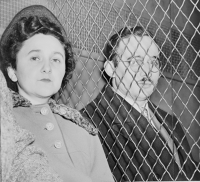
Judge Irving Kaufman told Julius and Ethel Rosenberg that their crime was "worse than murder" before sentencing them to death on April 5, 1951, for conspiring to transmit atomic bomb secrets to the Soviet Union. Kaufman said their espionage had altered the course of history to the disadvantage of the United States and had directly contributed to communist aggression in Korea. The sentence was controversial at the time and has become more so as subsequent evidence revealed that the case against Ethel was substantially weaker than prosecutors claimed. Julius Rosenberg had been recruited by Soviet intelligence in 1942 and operated a small espionage network that included his brother-in-law David Greenglass, a machinist at the Los Alamos nuclear weapons laboratory. Greenglass provided sketches and descriptions of implosion lens components used in the plutonium bomb. Harry Gold served as the courier between Greenglass and his Soviet handler. The network was exposed after the 1950 arrest of Klaus Fuchs, a German-born physicist who had provided far more valuable atomic intelligence to the Soviets and received only 14 years in a British prison. The case against Ethel Rosenberg rested primarily on Greenglass's testimony that she had typed up his handwritten notes for transmission to the Soviets. Decades later, Greenglass admitted he had lied. In a 2001 interview, he stated that his wife Ruth had actually done the typing but that he had named Ethel instead to protect Ruth and keep her out of prison so she could care for their children. Prosecutors had apparently encouraged this substitution. The government's strategy was to use the threat against Ethel as leverage to make Julius confess and name other members of his network. Julius refused. The Rosenbergs were executed at Sing Sing prison on June 19, 1953, maintaining their innocence to the end. Ethel required three applications of electric current before she was pronounced dead. Declassified Soviet cables from the VENONA project, released in 1995, confirmed that Julius was indeed a Soviet agent but provided no definitive evidence of Ethel's involvement beyond awareness of her husband's activities. Their two sons, Michael and Robert Meeropol, spent decades campaigning to clear their parents' names.
April 5, 1951
75 years ago
Key Figures & Places
What Else Happened on April 5
He didn't return to conquer; he came back to kneel. In 456, Patrick dragged himself through mud and fear, leaving behind his Roman life to face a king who might…
Pope Paschal I crowned Lothair I as King of Italy in Rome, formalizing the Carolingian grip on the Italian peninsula. This ceremony solidified the alliance betw…
Al-Qa'im bi-Amr Allah marched out of Raqqada with his heir's crown and a starving army, aiming for Egypt's grain stores. Thousands died in the dust before they …
A desperate plea for help from Pope Urban II arrived just as Alexios I Komnenos stepped onto the imperial throne in Constantinople. He wasn't a hero; he was a m…
Alexander Nevsky positioned his forces on the frozen surface of Lake Peipus on April 5, 1242, and waited for the Teutonic Knights to charge. The heavily armored…
He smashed through Porta del Popolo to force his way in, leveling whole city blocks just to pretend he was an ancient emperor. But hundreds of Roman families wa…
Talk to History
Have a conversation with historical figures who witnessed this era. Ask questions, explore perspectives, and bring history to life.