Argentina Invades Falklands: War with Britain Begins
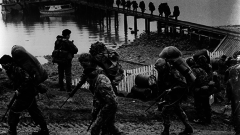
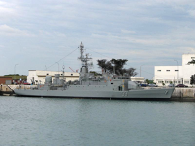
Argentina's military junta launched Operation Rosario on April 2, 1982, landing 600 marines on the Falkland Islands and overwhelming the 68 Royal Marines defending the capital, Stanley. The invasion was a calculated gamble by General Leopoldo Galtieri, whose regime was collapsing under economic crisis and popular unrest. Galtieri bet that seizing the Malvinas, as Argentina called the islands, would ignite patriotic fervor and that Britain, 8,000 miles away, would not fight to reclaim a windswept archipelago of 1,800 sheep farmers. He was wrong about Britain. Prime Minister Margaret Thatcher, facing her own political difficulties with unemployment above 3 million and approval ratings at historic lows, dispatched a naval task force within three days. The fleet included two aircraft carriers, HMS Hermes and HMS Invincible, nuclear submarines, destroyers, frigates, and requisitioned civilian ships including the ocean liner QE2, which transported 3,000 troops south. The logistics of projecting military power across 8,000 miles of open ocean with no nearby bases represented one of the most ambitious naval operations since World War II. The junta's military planning was as reckless as its political calculation. Argentine conscripts, many of them teenagers from tropical northern provinces, were poorly equipped for the Falklands' brutal winter conditions. Their officers had trained for counterinsurgency against domestic political opponents, not conventional warfare against a professional military. The Argentine air force performed brilliantly, sinking six British ships with Exocet missiles and iron bombs, but could not compensate for inadequate ground forces. British forces landed at San Carlos Water on May 21 and fought a series of engagements across East Falkland, culminating in the battles for Goose Green and the mountains surrounding Stanley. Argentine forces surrendered on June 14, 74 days after the invasion. The war killed 649 Argentine military personnel, 255 British, and 3 Falkland Island civilians. Galtieri's junta fell within days. Thatcher won a landslide reelection the following year. The Falklands remain British.
April 2, 1982
44 years ago
Key Figures & Places
What Else Happened on April 2
Mehmed II positioned his massive bronze cannons before the walls of Constantinople, initiating a siege that shattered the final remnants of the Byzantine Empire…
Juan Ponce de León waded ashore on the Florida coast, claiming the peninsula for the Spanish Crown under the name La Florida. This expedition initiated centurie…
He thought he'd found an island full of gold and youth springs, not a swampy peninsula. Ponce de León's men suffered scurvy and heatstroke while mapping a land …
Juan Ponce de Leon made landfall near present-day St. Augustine on April 2, 1513, naming the land "La Florida" because he arrived during Pascua Florida, the Spa…
J. S. Bach premiered his cantata "Bleib bei uns, denn es will Abend werden" (BWV 6) in Leipzig on Easter Monday, weaving a luminous oboe melody through a medita…
Commodore William James shattered the perceived invincibility of the Maratha Navy by capturing the fortress of Suvarnadurg with a small squadron. This victory d…
Talk to History
Have a conversation with historical figures who witnessed this era. Ask questions, explore perspectives, and bring history to life.