

Ironclads Clash at Hampton Roads: Wooden Ships Obsolete
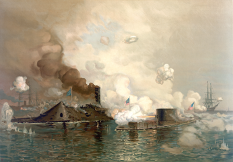
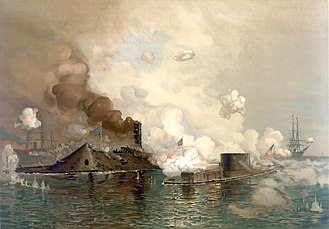
Two armored warships fired at each other for four hours at close range in Hampton Roads, Virginia, on March 9, 1862, and neither could sink the other. The battle between the USS Monitor and the CSS Virginia (built on the hull of the captured USS Merrimack) was the first engagement between ironclad vessels, and it rendered every wooden warship in every navy on Earth obsolete overnight. The age of sail effectively ended in a single morning. The Virginia had demonstrated the vulnerability of wooden ships the day before. On March 8, the ironclad steamed out of Norfolk and attacked the Union blockade fleet at Hampton Roads. The USS Cumberland, a 24-gun sloop, fired a full broadside at the Virginia. The shots bounced off. The Virginia rammed the Cumberland and sank her, then turned on the USS Congress, which ran aground while trying to escape. The Virginia set the Congress on fire with heated shot, killing over 120 sailors. The wooden frigate USS Minnesota ran aground trying to flee. Two Union warships were destroyed and a third crippled in a single afternoon. The Union's answer arrived that night. The Monitor, designed by Swedish-American engineer John Ericsson and built in just 100 days at the Continental Iron Works in Brooklyn, was towed into Hampton Roads after a harrowing coastal voyage during which it nearly sank. The vessel was radically unconventional: a flat iron raft barely above the waterline with a single revolving gun turret housing two 11-inch Dahlgren smoothbore cannons. The two ironclads engaged at close range on the morning of March 9. The Monitor's turret rotated to fire at the Virginia from various angles; the Virginia attempted to ram and fired repeatedly at the Monitor's armor. Neither vessel could penetrate the other's iron plating. After four hours of fighting, the Virginia withdrew when the tide began falling, and the Monitor did not pursue. The engagement was tactically a draw. Strategically, the battle was a Union victory. The Virginia was contained and never again threatened the blockade fleet. More importantly, the battle electrified naval architects worldwide. Britain and France accelerated their own ironclad programs, and within a decade, wooden warships had vanished from every major navy. The Monitor sank in a storm off Cape Hatteras on December 31, 1862, nine months after its famous fight. Its turret was recovered from the ocean floor in 2002.
March 9, 1862
164 years ago
Key Figures & Places
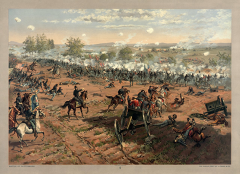
American Civil War
Wikipedia
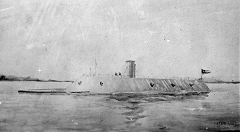
CSS Virginia
Wikipedia
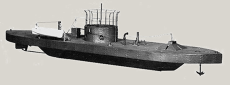
USS Monitor
Wikipedia
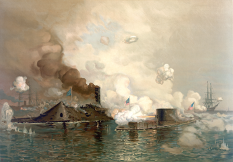
Battle of Hampton Roads
Wikipedia
Ironclad warship
Wikipedia

American Civil War
Wikipedia

USS Monitor
Wikipedia

CSS Virginia
Wikipedia

USS Merrimack (1855)
Wikipedia

Battle of Hampton Roads
Wikipedia
Ironclad warship
Wikipedia

Hampton Roads
Wikipedia

Battleship
Wikipedia
What Else Happened on March 9

Emperor Wu of Han took the Chinese throne at age fifteen in 141 BC and held it for 54 years, the longest reign in Chinese imperial history until the Kangxi Empe…
Liu Che ascended the throne as Emperor Wu, initiating a fifty-four-year reign that transformed China into a centralized Confucian state. By expanding imperial b…
100,000 pilgrims heard Muhammad deliver what nobody knew would be his final words at Mount Arafat. The sermon lasted just minutes, but Muhammad made his scribe …
Monks at the Quedlinburg Abbey recorded the name Litua for the first time in 1009, documenting the death of Saint Bruno of Querfurt during his mission to conver…
The emperor's mistress got her own palace wing, wore purple silks reserved for empresses, and sat beside Constantine IX at state banquets while his actual wife …
Jalal ad-Din Mingburnu seized Tbilisi, slaughtering thousands of its Christian inhabitants and forcing the Georgian royal court to flee to Kutaisi. This brutal …
Talk to History
Have a conversation with historical figures who witnessed this era. Ask questions, explore perspectives, and bring history to life.