

Barbarossa Elected King: Holy Roman Empire Rises
Frederick I Barbarossa secured the German throne in 1152, immediately launching a campaign to reassert imperial authority over Italy and reshape the Holy Roman Empire's power dynamics. His subsequent coronation as Emperor two years later cemented Hohenstaufen dominance for decades while intensifying conflicts with the Papacy that defined medieval European politics.
March 4, 1152
874 years ago
Key Figures & Places
Germany
Wikipedia
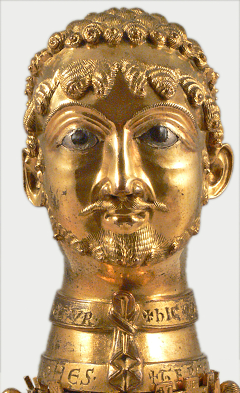
Frederick I, Holy Roman Emperor
Wikipedia
Germanic king
Wikipedia

Friedrich I
Wikipedia
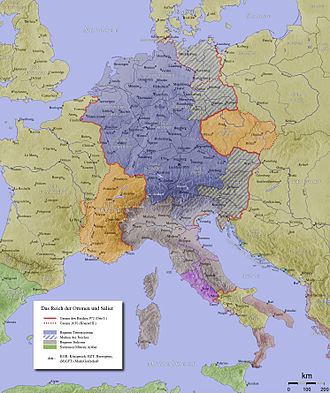
List of monarchs of Germany
Wikipedia

Liste des souverains du Saint-Empire
Wikipedia

Conrad III of Germany
Wikipedia

Duchy of Swabia
Wikipedia

Hohenstaufen
Wikipedia

Geschichte von Frankfurt am Main
Wikipedia

King of the Romans
Wikipedia
Kingdom of Germany
Wikipedia
What Else Happened on March 4
Roman soldiers executed Adrian of Nicomedia after he converted to Christianity upon witnessing the steadfast faith of prisoners he was tasked to guard. His deat…
Claudius officially designated his stepson Nero as princeps iuventutis, signaling his status as the empire's heir apparent. This title fast-tracked the teenager…
Roman soldiers executed Adrian of Nicomedia for refusing to sacrifice to pagan gods during the Great Persecution under Emperor Diocletian. His public defiance a…
The Roman executioner couldn't do it. Adrian of Nicomedia, imperial officer in charge of torturing Christians, watched prisoners refuse to renounce their faith …
He'd just been regent for his grandson — but Yang Jian couldn't resist. The former Northern Zhou general forced the seven-year-old emperor to abdicate and crown…
The first time Croats called themselves Croats in their own language wasn't carved on a monument or proclaimed in a grand hall. Knyaz Trpimir I scratched it int…
Talk to History
Have a conversation with historical figures who witnessed this era. Ask questions, explore perspectives, and bring history to life.