Spirit Lands on Mars: Red Planet Explored
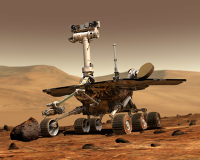
The signal took ten minutes to cross the 106 million miles between Mars and Earth, but when it arrived at the Jet Propulsion Laboratory in Pasadena on January 15, 2004, the control room erupted. NASA's Spirit rover had rolled off its landing platform and planted its six wheels on Martian soil, the first of two robotic geologists that would rewrite the scientific understanding of Mars over the next decade and a half. Spirit had landed in Gusev Crater on January 3 after a seven-month journey, cushioned by airbags that bounced it across the surface more than two dozen times before coming to rest. The twelve days between landing and rolloff were spent unfolding solar panels, calibrating instruments, and photographing the terrain. When Spirit finally drove off its lander on January 15, it became the most capable mobile science platform ever deployed on another planet, equipped with cameras, spectrometers, a rock abrasion tool, and a microscopic imager. The rover's primary mission was scheduled to last ninety days. Spirit operated for more than six years. Its twin, Opportunity, which landed on the opposite side of Mars on January 25, 2004, would last nearly fifteen years. Together, they produced some of the most important discoveries in the history of planetary science. Spirit found evidence of ancient hot springs and water-altered minerals in Gusev Crater. Opportunity discovered sedimentary rocks and mineral deposits at Meridiani Planum that could only have formed in the presence of liquid water. The finding that Mars once had surface water capable of supporting microbial life transformed the search for extraterrestrial life from speculation into a focused scientific program. The Mars Science Laboratory, Curiosity, and the Perseverance rover all followed paths that Spirit and Opportunity had opened. Spirit's journey ended in 2010 when it became stuck in soft soil and its solar panels could no longer generate enough power to survive the Martian winter. Its last communication came on March 22, 2010. A ninety-day mission that lasted 2,208 days, Spirit proved that engineering ambition and planetary science could combine to exceed every expectation.
January 15, 2004
22 years ago
Key Figures & Places
What Else Happened on January 15
Nebuchadnezzar II of Babylon laid siege to Jerusalem on January 15, 588 BC, beginning a thirty-month blockade that would end with the city's destruction, the bu…
Otho seized the Roman imperial throne on January 15, 69 AD, by orchestrating the murder of Emperor Galba in the Roman Forum and securing the allegiance of the P…
A king who couldn't get divorced. So he invented his own church. Henry VIII simply rewrote the religious rulebook to annul his marriage to Catherine of Aragon, …
A royal charter scrawled on parchment, and suddenly Canada becomes a divine real estate project. Francis I handed Roberval 50,000 square miles of frozen wildern…
Elizabeth Tudor walked into Westminster Abbey on January 15, 1559, under a canopy of state, wearing crimson velvet robes over a cloth-of-gold dress, and emerged…
The Livonian War ended not with a bang, but with a map redrawn in Polish ink. Russia's Ivan the Terrible — who'd spent decades battling for these Baltic territo…
Talk to History
Have a conversation with historical figures who witnessed this era. Ask questions, explore perspectives, and bring history to life.