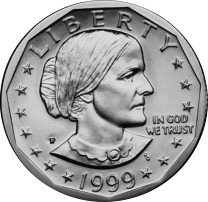
Susan B. Anthony Dollar: First Woman on U.S. Coin
The United States Mint began striking the Susan B. Anthony dollar on December 13, 1978, at the Philadelphia Mint, producing the first American coin to feature a real, historical woman on its face. Previous coins had used allegorical female figures like Liberty, but Anthony was the first named individual woman to appear on circulating U.S. currency. Susan Brownell Anthony had been the dominant figure in the American women's suffrage movement for over fifty years, from the 1850s through her death in 1906. She was arrested in 1872 for voting in a presidential election in Rochester, New York, at a time when women were legally prohibited from voting. She was tried, convicted, and fined $100, which she refused to pay. The Nineteenth Amendment, ratified in 1920, is sometimes called the Susan B. Anthony Amendment. The coin entered circulation in July 1979 and was immediately unpopular. Its size and color were nearly identical to the quarter, causing constant confusion in vending machines, cash registers, and pockets. The public rejected it. The Mint produced over 800 million Anthony dollars between 1979 and 1981, but most ended up in Federal Reserve vaults rather than in circulation. The design failure was a missed opportunity. The choice to honor Anthony was itself significant, representing the first time the U.S. government acknowledged a specific woman's contribution to American history on the coins people used daily. But the coin's practical failures overshadowed its symbolic importance. A small additional run was minted in 1999 to meet demand from transit authorities and vending machine operators before the Sacagawea dollar replaced it in 2000. The Sacagawea coin was gold-colored and smooth-edged, specifically designed to be distinguishable from the quarter. It fared better in practice but was also largely rejected by the public, who preferred paper dollars. The Anthony dollar remains historically significant as the moment the United States finally placed a real woman on its currency, and as a case study in how poor design can undermine a powerful idea.
December 13, 1978
48 years ago
What Else Happened on December 13
Robert Guiscard's forces force Salerno's surrender, shattering Norman control over southern Italy and leaving only the citadel under Duke Gisulf's stubborn defe…
An 85-year-old hermit who lived in a cave, ate roots, and hadn't seen Rome in decades became Pope in July 1294. Pietro del Morrone never wanted it. Cardinals ch…
Catholic bishops and theologians convened in Trent to launch a sweeping institutional overhaul in response to the Protestant Reformation. By codifying core doct…
The last priest arrived three years late. Paul III called the council in 1542, but wars between France and the Holy Roman Empire kept delaying it. When bishops …
Sir Francis Drake departed Plymouth with five ships, initiating the second circumnavigation of the globe in history. By returning three years later with a hold …
Twelve men deciding guilt or innocence — the English brought it, but Plymouth made it stick first. Not in Jamestown, where martial law still ruled. Not in Massa…
Talk to History
Have a conversation with historical figures who witnessed this era. Ask questions, explore perspectives, and bring history to life.