Sakharov Wins Nobel: Voice Against Nuclear Arms
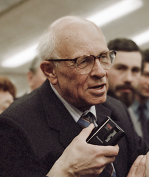
The man who had designed the Soviet Union's hydrogen bomb became its most prominent dissident, and on October 9, 1975, the Norwegian Nobel Committee awarded Andrei Sakharov the Peace Prize for what it called his "fearless personal commitment" to human rights and nuclear disarmament. The Soviet government, furious, barred Sakharov from traveling to Oslo. His wife, Yelena Bonner, accepted the award on his behalf. Sakharov's journey from weapons designer to peace activist traced the moral arc of the nuclear age. Born in Moscow in 1921, he showed extraordinary mathematical talent from childhood and was recruited into the Soviet nuclear program at age 27. By 1953, he was the principal architect of the RDS-37, the Soviet Union's first true thermonuclear weapon — a device hundreds of times more powerful than the bombs that destroyed Hiroshima and Nagasaki. He was the youngest person ever elected to the Soviet Academy of Sciences and received every honor the state could bestow. The transformation began during nuclear testing. Sakharov calculated that the radioactive fallout from atmospheric tests was causing thousands of cancer deaths worldwide, and he began advocating for a test ban treaty. When his concerns were dismissed by Nikita Khrushchev — who told him to "leave politics to us" — Sakharov realized that the weapons establishment he had built had no mechanism for moral self-correction. Through the 1960s, his dissent broadened. His 1968 essay "Reflections on Progress, Peaceful Coexistence, and Intellectual Freedom" argued that nuclear war could only be prevented through convergence between capitalist and communist systems, open societies, and respect for human rights. The essay circulated as samizdat — underground self-published literature — and was eventually published in the Western press, making Sakharov an international figure. The Soviet government responded with escalating persecution. He was stripped of his security clearance and removed from weapons work. After publicly opposing the 1979 Soviet invasion of Afghanistan, he was exiled to the closed city of Gorky (now Nizhny Novgorod), where he was kept under KGB surveillance for nearly seven years. He conducted hunger strikes to pressure authorities into allowing Bonner to travel abroad for medical treatment. Mikhail Gorbachev personally telephoned Sakharov in December 1986, inviting him to return to Moscow. Sakharov spent his final three years as an elected member of the Congress of People's Deputies, advocating for democratic reform until his death from a heart attack in 1989.
October 9, 1975
51 years ago
Key Figures & Places

What Else Happened on October 9
Pepin the Short died in 768 and split his kingdom between his two sons. Carloman got the center. Charlemagne got a crescent of territory wrapping around it — ha…
Five centuries before Columbus reached the Caribbean, a Norse expedition led by Leif Erikson made landfall on the coast of North America, establishing a settlem…
James I of Aragon captured the city of Valencia from the Almohad Caliphate, ending five centuries of Islamic rule in the region. By establishing the Kingdom of …
Alfonso X of Castile captured the strategic city of Jerez, ending over five centuries of Muslim rule in the region. This victory dismantled a key stronghold of …
The Prague astronomical clock was first mentioned in 1410, making it the oldest working clock of its kind. It displays Babylonian time, Old Czech time, German t…
King Sejong published hangul, an alphabet designed from scratch for Korean. The writing system before that was Chinese characters, which took years to master an…
Talk to History
Have a conversation with historical figures who witnessed this era. Ask questions, explore perspectives, and bring history to life.