UN Adopts Human Rights Declaration: Global Standards Set
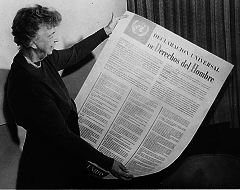
The United Nations Commission on Human Rights adopted the draft Universal Declaration of Human Rights on June 18, 1948, sending it forward for consideration by the General Assembly, which approved the final text on December 10, 1948, with 48 votes in favor, none against, and eight abstentions. Eleanor Roosevelt, who chaired the commission, described the declaration as a "Magna Carta for all mankind." The document established for the first time a universal standard of fundamental rights applicable to every person regardless of nationality, ethnicity, or religion. The declaration emerged from the ashes of World War II and the Holocaust. The revelation of Nazi genocide, the devastation of total war, and the failures of the League of Nations created political will for an international human rights framework that had not existed before. Roosevelt assembled a drafting committee that included Lebanese philosopher Charles Malik, Chinese diplomat Peng Chun Chang, French jurist Rene Cassin, and Canadian legal scholar John Humphries, whose initial 400-page draft was distilled into thirty concise articles. The document proclaimed rights to life, liberty, security, fair trial, education, work, and freedom from torture, slavery, and arbitrary detention. Article 1 declared that "all human beings are born free and equal in dignity and rights." The abstaining nations included the Soviet Union, Saudi Arabia, and South Africa, each objecting to specific provisions that challenged their domestic practices: the Soviets resisted individual rights over state authority, Saudi Arabia objected to the right to change religion, and South Africa opposed racial equality provisions that contradicted apartheid. The declaration is not legally binding, but its principles have been incorporated into the constitutions of most nations established since 1948 and form the basis of international human rights law, including the legally binding International Covenant on Civil and Political Rights and the International Covenant on Economic, Social and Cultural Rights.
June 18, 1948
78 years ago
Key Figures & Places
What Else Happened on June 18
Li Yuan, the Duke of Tang, forced the abdication of the last Sui emperor and ascended the throne as Emperor Gaozu on June 18, 618 AD, founding a dynasty that wo…
Uthman ibn Affan was murdered by rebels in his own home, and suddenly Islam's most powerful office sat empty. Ali ibn Abi Talib — the Prophet Muhammad's cousin …
200 ships appeared without warning in the Bosphorus, and Constantinople had almost no navy left to stop them. Emperor Michael III was away campaigning in Asia M…
The Pope led an army into battle and lost. Leo IX personally marched against the Normans in southern Italy, convinced God would deliver victory. He was wrong. H…
Five monks in Canterbury looked up and watched the Moon split open. On June 18, 1178, they described a flaming torch spewing fire, hot coals, and sparks — the l…
Ireland's first parliament didn't meet in a grand capital. It met in Castledermot — a small monastic town in Kildare, barely a dot on the map. Anglo-Norman lord…
Talk to History
Have a conversation with historical figures who witnessed this era. Ask questions, explore perspectives, and bring history to life.