Gorbachev Becomes President: The Soviet Union Transforms
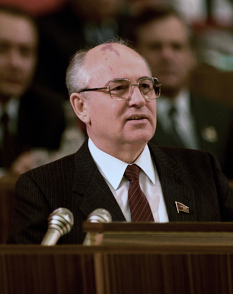
The Soviet Congress of People's Deputies elected Mikhail Gorbachev as the first executive president of the Soviet Union on March 14, 1990, creating a powerful new office that was supposed to stabilize the reforming communist state. The position gave Gorbachev authority independent of the Communist Party for the first time, but the country he now led was already fracturing along national, economic, and ideological lines that no amount of presidential power could hold together. Gorbachev had introduced glasnost and perestroika beginning in 1985, policies intended to modernize the Soviet system through transparency and economic restructuring while preserving the Communist Party's leading role. By 1990, those reforms had unleashed forces he could not control. Lithuania had declared independence on March 11, just three days before Gorbachev's election as president. Nationalist movements were surging in the Baltic states, the Caucasus, Ukraine, and Central Asia. The new presidential office was designed to give Gorbachev a power base outside the party apparatus, which was increasingly divided between hardline conservatives who wanted to reverse reforms and radical reformers who wanted to accelerate them. The Congress voted 1,329 to 495 to create the presidency, but Gorbachev was the only candidate, and the absence of a popular mandate weakened his legitimacy from the start. Gorbachev used his presidential powers to pursue the New Union Treaty, an attempt to renegotiate the relationship between Moscow and the Soviet republics on a voluntary federal basis. The negotiations dragged through 1990 and into 1991 as republic after republic declared sovereignty. Boris Yeltsin's election as president of the Russian republic in June 1991 created a rival power center that further eroded Gorbachev's authority. The August 1991 coup attempt by hardliners, intended to reverse the dissolution, instead accelerated it. Gorbachev resigned as president on December 25, 1991, and the Soviet Union ceased to exist the following day. The presidency Gorbachev created outlived the country it was designed to save by exactly twenty-one months.
March 14, 1990
36 years ago
Key Figures & Places
What Else Happened on March 14
The night before they killed Julius Caesar, the conspirators nearly decided to kill Mark Antony too. On the evening of March 14, 44 BC, Gaius Cassius Longinus a…
Liu Cong, ruler of the Han Zhao state, ordered the execution of the captive Emperor Jin Huidi by poisoning him with a cup of wine. This act dismantled the Jin d…
The king lost to his own cousins in a single afternoon. At Mogyoród, Géza and Ladislaus faced Solomon—not a foreign invader, but their own blood, the crowned Ki…
The fishermen of Chioggia betrayed their mother city. In 1381, this tiny Venetian lagoon town — barely three miles from the Doge's Palace — signed a secret pact…
Catherine Cornaro ceded the sovereignty of Cyprus to the Venetian Republic, ending her reign as the island’s final monarch. By surrendering her crown, she allow…
Henry of Navarre commanded his cavalry charge at Ivry with white plumes streaming from his helmet, shouting to his outnumbered Huguenot troops: "Follow my panac…
Talk to History
Have a conversation with historical figures who witnessed this era. Ask questions, explore perspectives, and bring history to life.