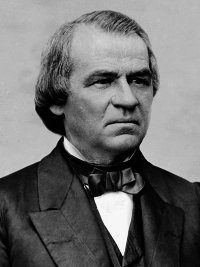
Johnson Impeached: First President Faces Trial in 1868
For the first time in American history, a sitting president stood trial before the United States Senate. The impeachment proceedings against Andrew Johnson opened on March 13, 1868, after the House of Representatives voted 126-47 to impeach him on eleven articles, most centered on his defiance of the Tenure of Office Act by removing Secretary of War Edwin Stanton without Senate approval. The real conflict was about Reconstruction. Johnson, a Tennessee Democrat who had been Lincoln's running mate on the 1864 National Union ticket, clashed relentlessly with the Republican-controlled Congress over the treatment of the defeated Confederacy. Johnson vetoed civil rights legislation, opposed the Fourteenth Amendment, and used his executive power to obstruct Republican efforts to protect formerly enslaved people in the South. By 1867, Congress had overridden fifteen of his vetoes. The Tenure of Office Act, passed over Johnson's veto in March 1867, prohibited the president from removing certain officeholders without Senate consent. When Johnson fired Stanton, who had been enforcing Reconstruction policies that Johnson opposed, Republicans saw their opportunity. The House impeached Johnson within eleven days. The Senate trial lasted from March 13 to May 26, 1868, with Chief Justice Salmon P. Chase presiding. Johnson's defense team argued that the Tenure of Office Act was unconstitutional and that the president had the right to test the law by violating it. The prosecution countered that Johnson had systematically undermined the will of Congress and the rights of freed people. On May 16, the Senate voted 35-19 for conviction on Article XI, falling one vote short of the two-thirds majority required. Seven Republican senators broke with their party to vote for acquittal, believing that removing a president over a policy disagreement would permanently damage the separation of powers. Johnson's acquittal established that impeachment requires more than political opposition, a precedent that continues to shape American constitutional law.
March 13, 1868
158 years ago
Key Figures & Places
What Else Happened on March 13
The Praetorian Guard dragged both bodies through Rome's streets before dumping them in the Tiber River. Elagabalus was eighteen when soldiers murdered him in th…
The Roman Senate chose him — not the clergy. Felix III became pope in 483 because Gothic King Odoacer, who'd deposed the last Western Roman emperor seven years …
Three hundred thirteen men defeated an army three times their size and changed the trajectory of a religion. The Battle of Badr on March 13, 624 CE, fought at t…
Three hundred thirteen men faced a thousand. Muhammad's followers were outnumbered three-to-one at Badr's wells, seventy miles from Medina, but they'd seized th…
The remains of Saint Nicephorus returned to Constantinople, finding their final resting place in the Church of the Holy Apostles. This ceremonial reburial signa…
Cardinal Gregorio Conti assumed the title of Victor IV, challenging the legitimacy of Pope Innocent II after the death of Anacletus II. This schism deepened the…
Talk to History
Have a conversation with historical figures who witnessed this era. Ask questions, explore perspectives, and bring history to life.